
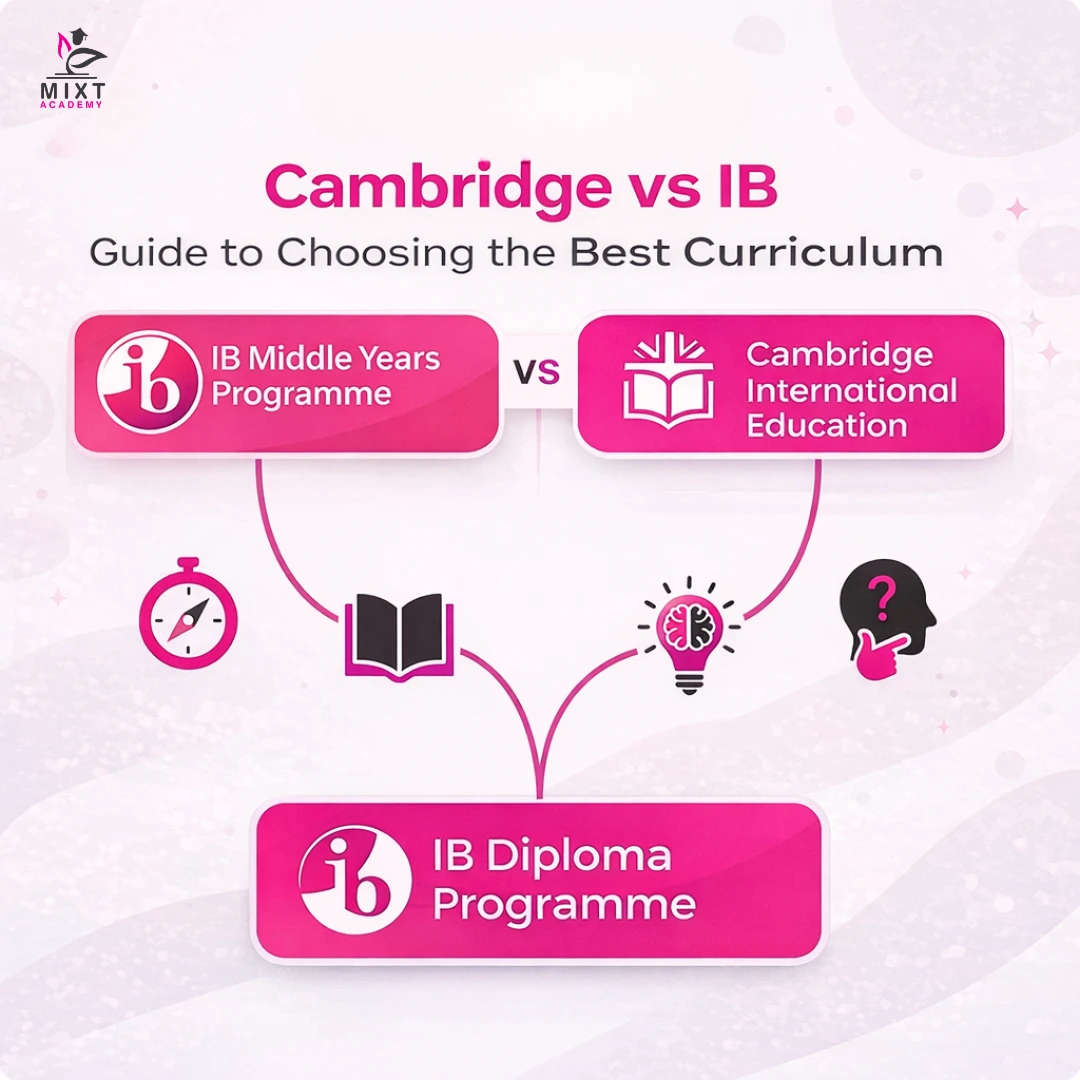
Choosing a school curriculum is one of the most important decisions for a student or their parents, and among the most respected international education pathways are the Cambridge and IB curricula. They are both globally recognised, academically difficult, and prepare students for further education; however, their approaches to teaching, assessment, and learning outcomes differ.
This guide examines the differences between IB and Cambridge, explains the meaning of “Cambridge vs. IB,” discusses topics such as “is IB harder than Cambridge,” explores university preparation (Cambridge vs. IB), and compares curricula to help parents and students make an informed decision.
Understanding the Cambridge vs IB Curriculum
Cambridge Curriculum Overview
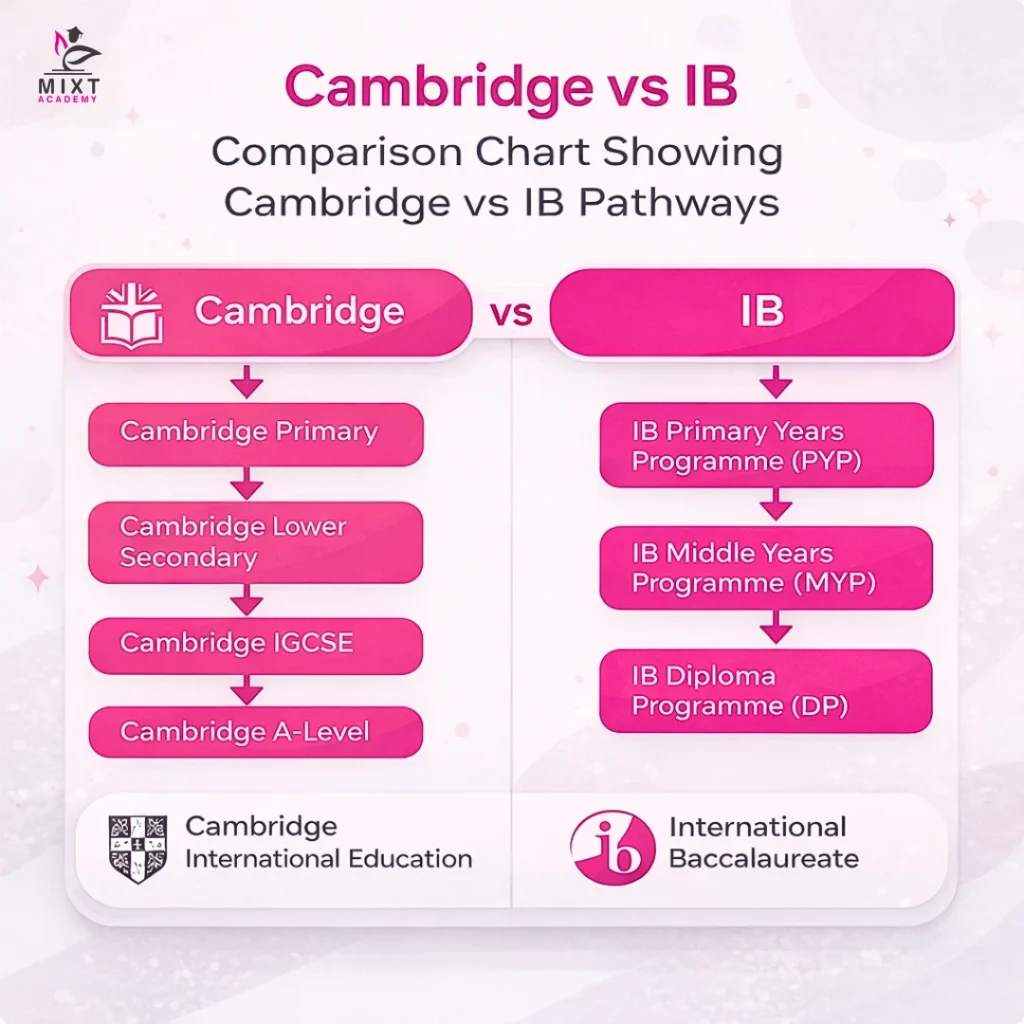
Offered by Cambridge Assessment International Education, the Cambridge Curriculum is quite popular. It has a more traditional structure and is more subject-centred than most other curriculum providers. Focusing more on the mastery and understanding of the core disciplines of English, math, and the sciences, plus a humanities and a language, the major milestones in the Cambridge Pathway are:
- Cambridge Primary: Focus on core literacy and numeracy skills.
- Cambridge Lower Secondary: Development of foundational knowledge in a wider range of subjects.
- Cambridge IGCSE Curriculum: A widely accepted certification for students between the ages of 14 and 16.
- Cambridge AS & A Levels: These are advanced studies for 16-19 year olds which allow specialisation in individual subjects.
The Cambridge system is particularly suitable for students who value structured learning and want to focus on subjects relevant to their careers or university aspirations. It is also great for developing analytical and problem-solving skills, particularly through the assessment of their examinations.
International Baccalaureate (IB) Curriculum Overview
The IB (International Baccalaureate) is a comprehensive, globally oriented curriculum that focuses on inquiry, critical thinking, and conceptual understanding. Within the IB curriculum, there are programmes for different age bands.
- Primary Years Programme (PYP): The Primary Years Programme (PYP) encourages inquiry and exploration in the earliest years.
- Middle Years Programme (MYP): The Middle Years Programme (MYP) focuses on building a student’s knowledge and critical thinking in the secondary years.
- IB Diploma Programme (DP): The IB Diploma Programme (DP) is designed for 16-19-year-olds and covers 6 subjects, along with additional core requirements, including the Extended Essay (EE), Theory of Knowledge (TOK), and the Creativity, Activity, and Service (CAS) component.
- Career-related Programme (CP): The Career-related Programme (CP) provides an integration of academic studies and vocational training.
The IB curriculum aims to develop students’ ability to inquire and think critically while addressing complex, real-world problems. The combination of the focus on research, reflection, and community service continues to build skills beyond the scholarly areas.
Key Philosophical Differences Between IB and Cambridge
Learning Philosophy
A key point of differentiation, alongside varying curricula, is the contrasting learning philosophies of the two systems, which shape how students learn. In this case, the IB system is more about the process of learning, while the Cambridge system focuses on learning outcomes.
Developing the learning process is central to the IB philosophy; as a result, IB students are prepared and encouraged to engage in critical and analytical thinking and to master the learning process. They achieve this through interdisciplinary learning and encouragement to develop analytical skills and build global connections.
The philosophy of Cambridge education is distinct, encouraging students to master the core concepts of a single subject. Each objective and clear assessment goal is structured to enable students to do so. At Cambridge, it is the depth of the subject, along with its precision, more than the system’s learning philosophy, that defines the education.
In simple terms, while IB focuses on how students are encouraged to think and develop creative and analytical skills, Cambridge focuses on mastering subject content.
Assessment Styles
The two systems also employ quite different assessments.
- In the IB system, students are assessed across many more dimensions than in Cambridge, where assessments are more narrowly focused. In IB, there are internal assessments, projects, and final examinations, all of which are compounded by the requirement to complete the Extended Essay, Theory of Knowledge, and the CAS core components.
- In Cambridge, particularly at IGCSE and A Level, assessments are exam-based, with coursework a secondary focus in some subjects.
IB awards points out of 45, while Cambridge has grades ranging from A* to E. This demonstrates how the IB focuses on the full picture, while Cambridge has a more pinpoint focus on the subjects.
Breadth vs Depth
The difference between IB and Cambridge can also be seen in the breadth vs. depth conversation.
- With the IB curriculum, students are required to take 6 subjects across all areas of study. This includes taking classes in 2 languages, the sciences, math, humanities, and the arts. This results in students receiving a more well-rounded education, ensuring intellectual flexibility.
- At Cambridge, students are allowed to specialise more, and this begins with the A Levels. Students are required to focus on 3 to 4 subjects, and they are able to build strong expertise in those areas.
In the breadth versus depth situation, the IB allows students a more balanced development. At the same time, Cambridge focuses on depth, enabling students to achieve mastery in a specific area to support academic or career goals.
Workload and Learning Style
The two curricula are quite different in the way they apply their workloads.
- In the IB system, students have to divide their focus evenly among all six of their subjects. This includes doing projects, research papers, and the CAS activities, which is why time management is so important.
- At Cambridge, the focus is on exam preparation, and the workload increases as assessments approach. Students benefit from having clear goals to work towards.
Cambridge vs IB Meaning Explained
The term Cambridge vs IB meaning refers to both equally respected, international educational systems:
- Cambridge assesses a student’s understanding through structured learning of individual subjects.
- IB offers both interdisciplinary learning and critical thinking by providing a more well-rounded approach to education.
Both facilitate entry to tertiary institutions and prepare students for international pathways. However, the two systems differ in how they cater to students, their individual learning needs, and future ambitions.
Confused About Which Curriculum Suits Your Child?
Discover a clear comparison and find the best fit for your child’s learning style.
A Comparative Analysis of IB vs. Cambridge
| Feature | IB | CIE |
|---|---|---|
| Full form | The full form of IB is International Baccalaureate | The full form of CIE is Cambridge International Education |
| Approach to Learning | Inquiry-based, focusing on critical thinking and research skills | Exam-oriented, focusing on a strong foundation in core subjects |
| Curriculum Structure | Defined framework with core programs (PYP, MYP, DP, CP) | Greater flexibility with individual subject choices within programs |
| Core Curriculum | Focuses on the core program with Theory of Knowledge, Creativity, Activity, Service (CAS), and the Extended Essay | No core curriculum; focuses solely on subject-specific knowledge and skills |
| Assessment | Internal assessments and external exams | Primarily relies on external, standardised exams |
| Learning Style | Suitable for students who thrive on inquiry-based learning and applying knowledge across disciplines | Ideal for students who excel in standardised exams and prefer a more traditional approach |
| Long-Term Goals | Well-suited for students aiming for universities that value critical thinking and international awareness | Can be beneficial for students seeking a strong foundation in core subjects for specific career paths |
| Availability | Offered by schools worldwide | Offered by schools worldwide |
| School Culture | Choose a school that aligns with your child’s personality and learning style | Consider the school’s approach to education and its overall culture |
| Fees | Generally, higher fees compared to other international curricula | May have higher fees compared to other national and international curricula |
| Language Options | Offers programs in various languages | Offers programs in various languages |
| University Recognition | Widely recognised by universities worldwide | Widely recognised by universities worldwide |
Is IB Harder Than Cambridge?
Many parents and students want to know, is IB harder than Cambridge?
- IB is viewed to be more difficult, but in reality, it is the depth of the subject matter that IB students have to deal with that makes it easier.
- Obtaining passing grades in each exam is the requirement, with Cambridge being more about the depth of individual subjects.
IB is seen as offering a heavier load due to the number of subjects paired with the continuous assessments. In Cambridge, students have exams, and that is it. For each system, individual traits and behaviours dictate which educational system is less difficult.
Unsure Which Pathway Matches Your Learning Strengths?
Let Mixt Academy help you identify the curriculum that works best for you.
Cambridge vs IB University Recognition
Global Acceptance
Both curricula have worldwide acceptance, but have different areas of focus:
- The IB Diploma Programme is viewed very positively throughout Europe, Canada, Asia, and especially the United States. Universities appreciate the IB’s focus on research and analytical thinking and help students grow in all areas.
- Cambridge A Levels and IGCSE are acknowledged throughout the UK, Commonwealth nations, and many international universities. A-Levels are particularly appreciated for their depth of study and exam performance.
Both systems are understood and evaluated by universities. The decision should be based on the students’ priorities, target schools, and aspirations.
University Preparation
Both pathways provide great preparation, but more widely developed skills are fostered by IB as opposed to specific subjects in which Cambridge builds deep knowledge.
- The IB supports Interdisciplinary study. It develops students’ research, writing, and critical thinking skills.
- Cambridge promotes more integrated learning. In further studies, strong preparation for specialised academic study is secured by deep subject learning and advanced exams.
International Baccalaureate vs Cambridge AICE
In discussions of global education, comparing the International Baccalaureate and the Cambridge AICE is common.
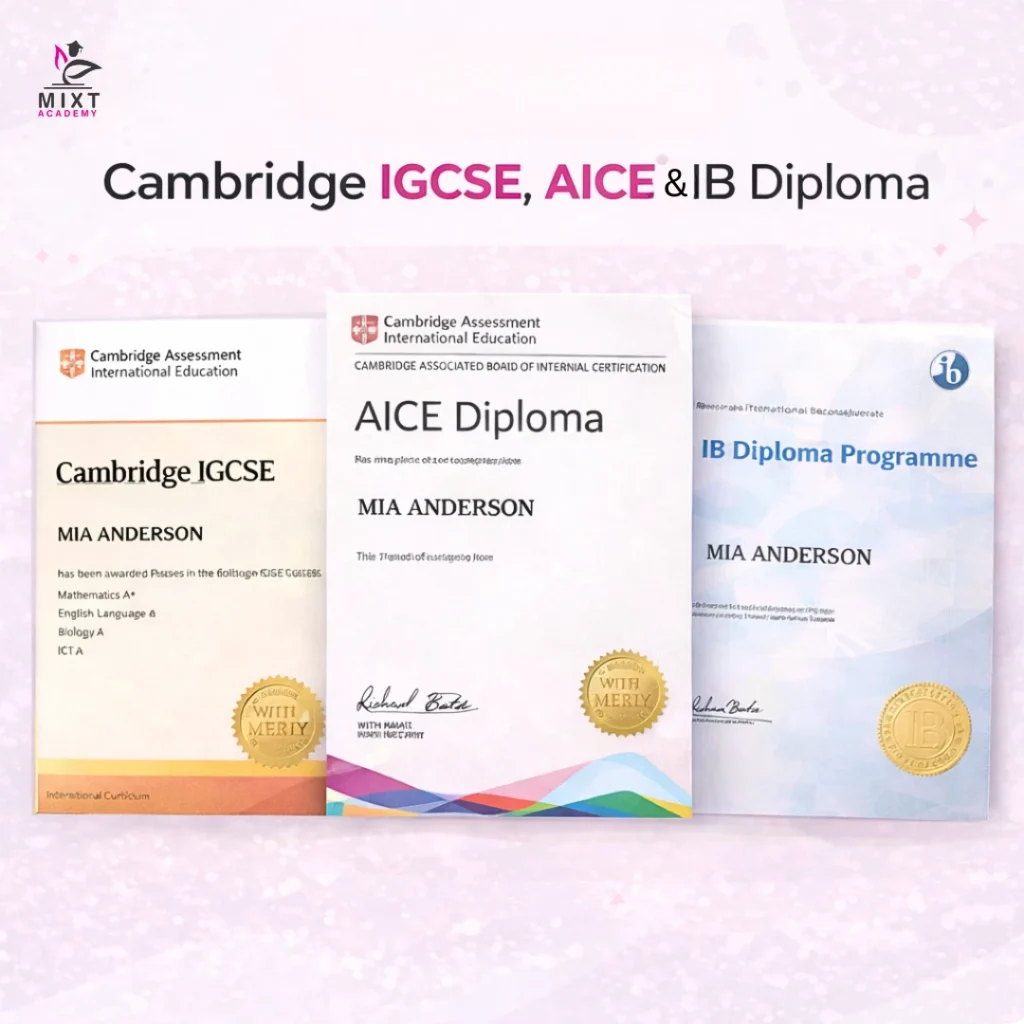
- In the AICE program, students can earn a Diploma, similar to an IB Diploma, by earning credits across various subject areas.
- IB Diplomas include Theory of Knowledge (TOK), the Extended Essay (EE), and Creativity, Activity, and Service (CAS) as core components, ensuring the development of analytical and research skills and subject knowledge.
Both diplomas show academic toughness and university readiness, yet the IB diploma promotes more growth, while the AICE diploma offers greater subject selection flexibility.
Cambridge IGCSE Curriculum
For students aged 14-16, the Cambridge IGCSE curriculum provides a solid foundation. Key components are:
- Also, providing the option of A-levels, the AICE Diploma, or the IB Diploma.
- Additional core subject coverage includes English, math, the sciences, the humanities, and languages.
- Structured syllabuses outlining learning frameworks.
The IGCSE curriculum promotes critical and analytical thinking along with the knowledge necessary to advance and study in depth.
Choosing Between Cambridge and IB
When making the choice between Cambridge vs IB education, the following factors are recommended as primary analysis:
Learning Style
- The IB curriculum is best suited for students who are inclined to research, enjoy learning in a project-based style, and value cross-discipline education.
- Cambridge is best suited to students who prefer an organised study approach with exam components and a focused depth in a few subjects.
Academic Goals
- Universities that prize a more analytical approach to student profiles tend to favour applicants with an IB diploma.
- If the goal is to attend a university that prizes excellent achievement in the subject(s), Cambridge is the best choice.
Student Strengths
- Students who excel in various disciplines can succeed in a broad-based IB curriculum.
- Students with strengths in individual subjects may achieve more in Cambridge.
Future Careers
- Graduates from IB often continue to study in fields that require interdisciplinary integration and an understanding of global systems.
- Graduates from Cambridge are generally prepared to study in fields that require in-depth knowledge and expertise in particular subjects.
Struggling to Plan the Right Academic Path for Your Future?
Get personalised guidance to make the best curriculum choice with expert support.
Making the Right Choice
Comparing the two systems of the Cambridge vs IB curriculum is to compare two structured yet flexible world educational systems. The difference between IB and Cambridge systems lies in their philosophy, assessment, breadth vs depth of curriculum, and their preparation for university.
No system is better than the other. The best system is the one that matches the students’ strengths, interests, learning style and career aspirations. Both IB and Cambridge systems are suited to preparing students for further academic study and lifelong learning.
Whether it is the more structured, subject-focused approach of Cambridge with the Cambridge IGCSE curriculum, or the more open, inquiry-based learning styles of IB, it is important to select the system that best meets the students’ goals and abilities. At Mixt Academy, we help students to understand what the Cambridge vs IB systems to ensure proper guidance and academic success.