
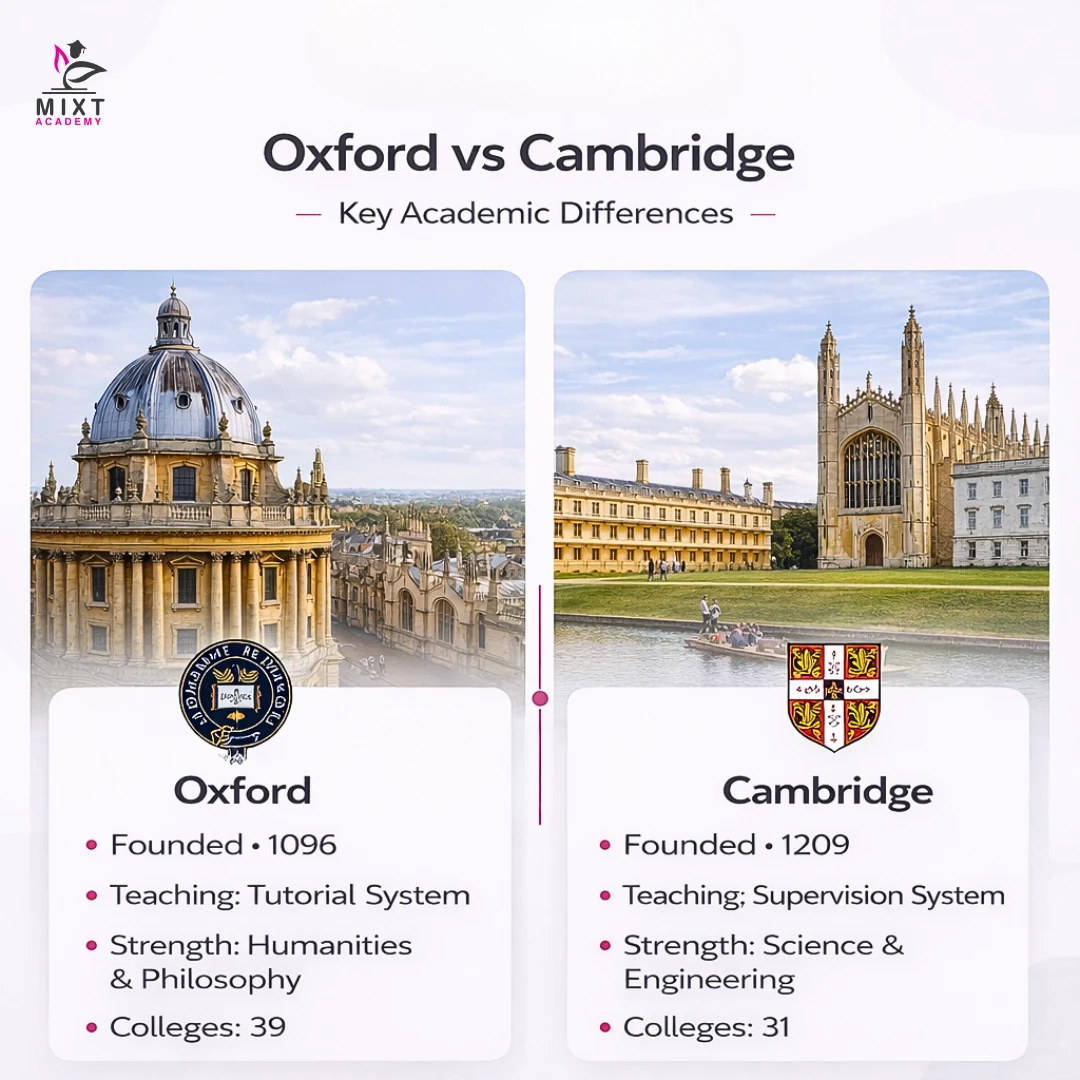
When deciding between Cambridge and Oxford, it’s also important to consider practical factors such as tuition fees. Tuition fees depend on the university, the specific course, and the student’s nationality, including UK, EU, and overseas students. Parents should review the current fee schedule to plan their finances accordingly.
Beyond academics, the cities themselves differ in their atmospheres. Cambridge is typically seen as more intimate and attractive, with a quieter, traditional feel, whereas Oxford offers a larger, livelier city experience. Ultimately, the best option is the one that aligns most closely with your child’s subject interests and personal comfort.
Not Sure Which Academic Course Is Right for Your Child?
Connect with Mixt Academy, a trusted tutoring platform that guides students toward the right academic path.
Understanding the Cambridge Syllabus
The Cambridge International syllabus, developed by Cambridge Assessment International Education (CAIE), is widely used around the world. It offers IGCSE and AS & A Level programmes across more than 70 subjects. The programme is designed for students aged 5 to 19 and focuses on developing critical thinking and problem-solving skills.
In addition, creativity and practical skills prepare learners for both university and future careers worldwide. The system offers flexibility in combining subjects, such as science and humanities, and includes core and extended learning options, with exams held globally in June and November.
Key Cambridge Qualifications & Features
- Primary (5–11 years): Builds foundational knowledge in core subjects and encourages curiosity, with optional Checkpoint assessments to track progress.
- Lower Secondary (11–14 years): Develops skills in English, Mathematics, and Science, preparing students for more advanced study.
- IGCSE (14–16 years): Offers over 70 subjects, fostering inquiry-based learning, academic confidence, and critical thinking, with core and extended tiers.
- AS & A Level (16–19 years): Enables deep specialisation in 55+ subjects, including Psychology, History, and Mathematics, providing students with a strong foundation for university study.
- Academic Excellence: Focus on intellectual growth, personal development, and social skills.
- Global Perspective: Encourages understanding of international issues and cultural awareness.
- Flexibility: Schools can adapt subjects and combinations to local contexts and student interests.
- Learner Development: Designed to help students become confident, responsible, reflective, innovative, and engaged individuals.
Example Subjects of Cambridge
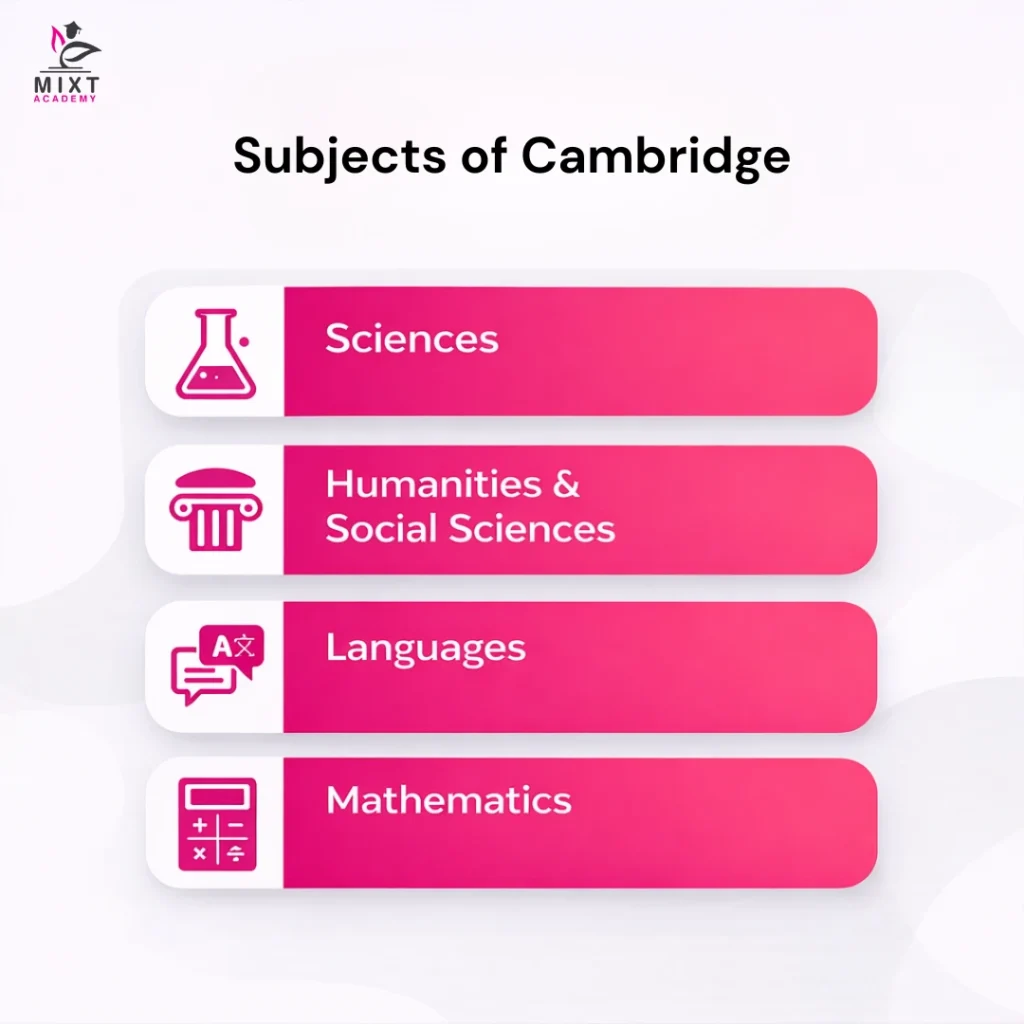
- Sciences: Physics, Chemistry, Biology, Environmental Management, Physical Science, Computer and Engineering Science.
- Humanities & Social Sciences: History, Geography, Psychology, Sociology, Business Studies, Economics, and Islamic Religion & Culture.
- Languages: English (First Language and Literature), Arabic, French, Spanish, Malay, and Mandarin.
- Mathematics: Standard Mathematics, Additional Mathematics, and International Mathematics.
How to Access a Specific Cambridge Syllabus?
To view detailed content, learning objectives, and assessment requirements for any subject, you can search for the specific syllabus code on the Cambridge International Education website. For example, you might search:
- Cambridge IGCSE Mathematics 0580 syllabus
- Cambridge AS & A Level Psychology 9990 syllabus
Need Help with Cambridge Subjects or IGCSE Preparation?
Mixt Academy offers expert tutoring for Cambridge IGCSE and A Level subjects, helping students strengthen concepts & improve exam performance.
Understanding the Oxford Syllabus
The Oxford International Curriculum is a structured framework designed to build strong academic foundations while developing critical thinking and practical skills. At the primary and lower secondary levels, it is often delivered through the New Oxford Modern English (NOME) series. This series is widely adopted in schools worldwide and supports both native and non-native speakers.
The curriculum uses a balanced approach to language learning, combining phonics with whole-word recognition. This method helps students develop reading, writing, speaking, and comprehension skills in a clear and engaging way.
Key Components of the Oxford Curriculum
The Oxford International Curriculum is a holistic, inquiry-based framework for students aged 2–19: it focuses on core subjects, wellbeing, global skills, and sustainability while promoting critical thinking, creativity, and digital literacy. The curriculum follows a spiral, progressive structure, supported by high-quality Oxford resources and assessments.
Oxford Core Academic Subjects
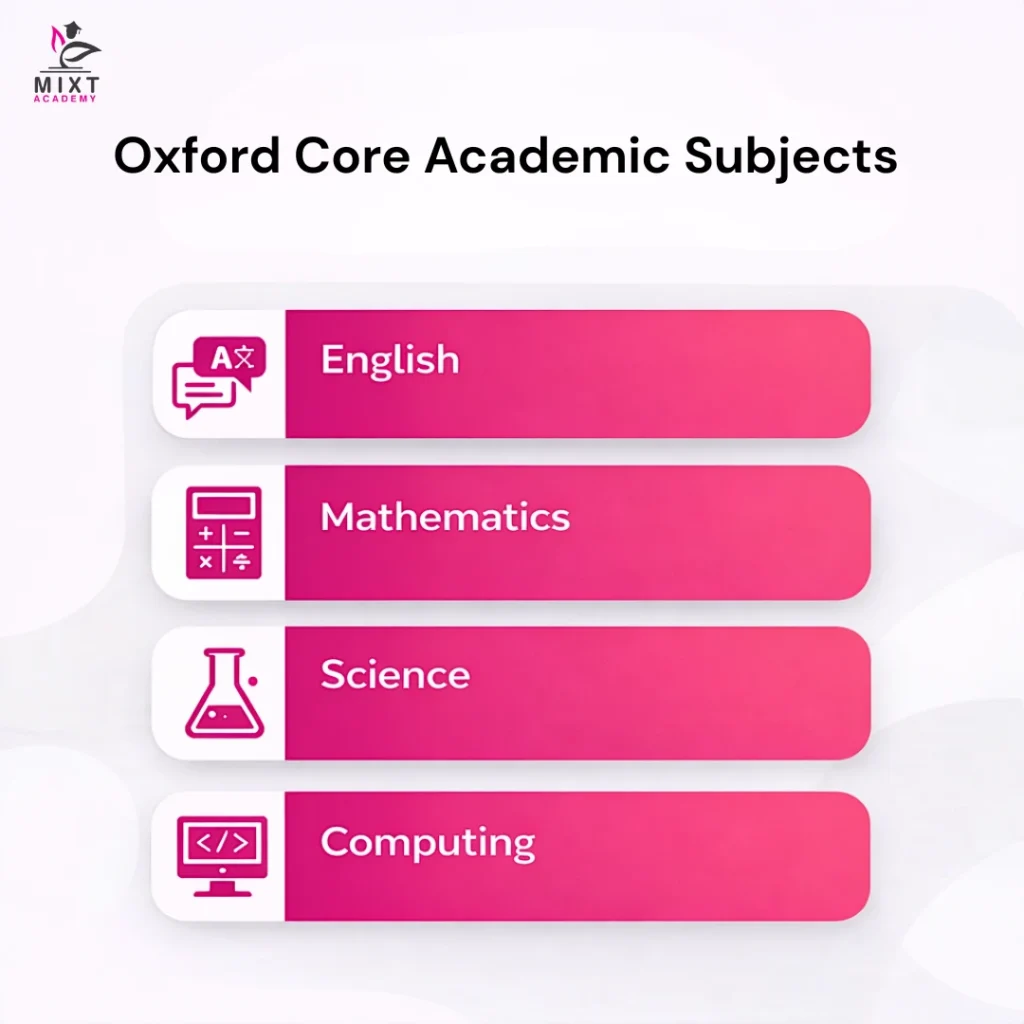
- English: Develops reading, writing, and communication skills through phonics, grammar, and literature.
- Mathematics: Develops problem-solving, data literacy, and logical reasoning skills.
- Science: Encourages curiosity through inquiry-based learning, observation, and practical experiments.
- Computing: Strengthens digital literacy and technical skills for the modern world.
Oxford Specialised Areas
- Wellbeing: Supports mental and physical health, including mindfulness, emotional growth, and healthy relationships.
- Global Skills Projects: Enhances creativity, critical thinking, and social skills through real-life, project-based learning.
- Sustainability: Educates students about environmental responsibility and global issues.
Oxford Educational Structure & Approach
- Inquiry-Based Learning: Encourages students to ask questions, explore topics, and independently discover knowledge.
- Assessment: Combines continuous formative assessments with summative tests and project evaluations.
- Resources: Supported by comprehensive, age-appropriate materials for effective teaching and learning.
Oxford Assessment and Progression
- Oxford International Standardised Assessments: Tracks student progress digitally at the end of primary and lower secondary levels.
- Pathways: Prepares students for International GCSEs, AS, and A levels, including the Oxford AQA qualifications.
The curriculum emphasises a “joy in learning,” fostering curiosity and a lifelong love for knowledge.
Teaching Methodology of Oxford
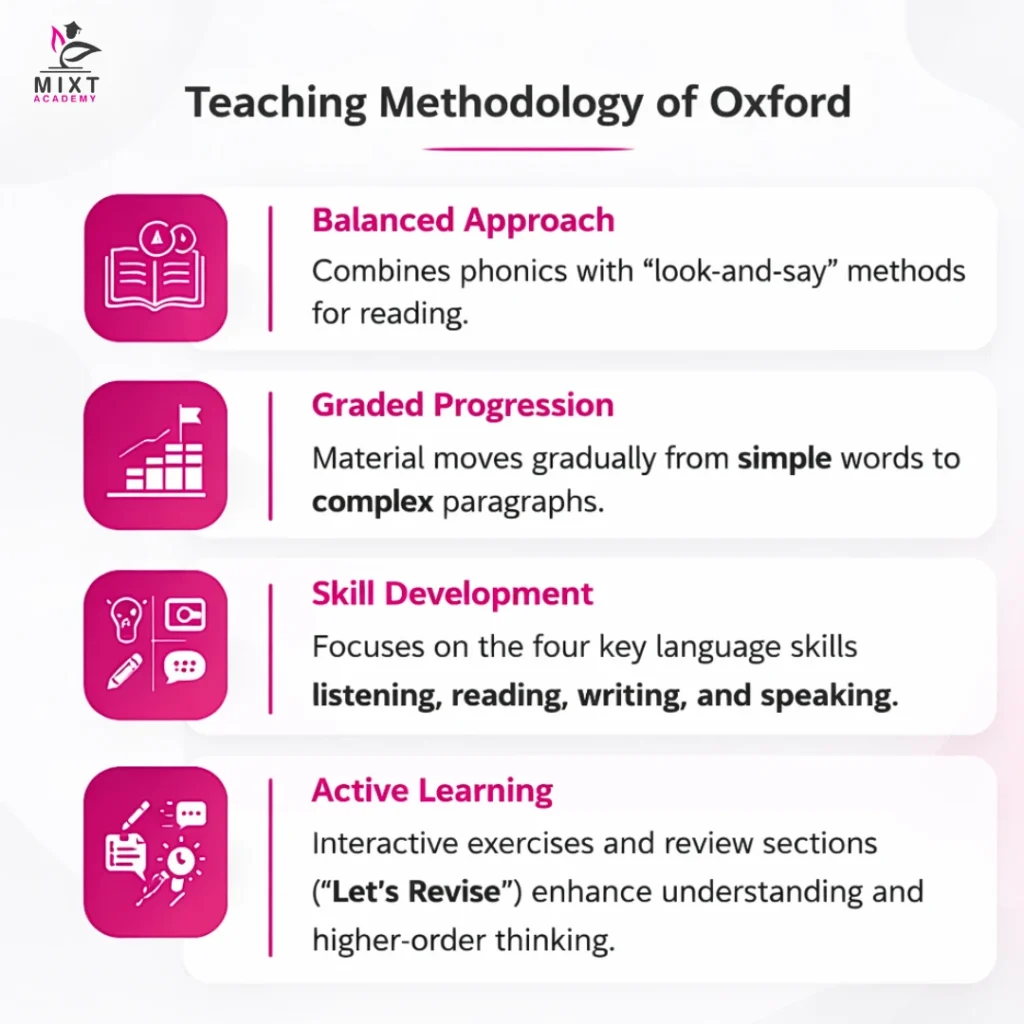
- Balanced Approach: Combines phonics with “look-and-say” methods for reading.
- Graded Progression: Material moves gradually from simple words to complex paragraphs.
- Skill Development: Focuses on the four key language skills: listening, reading, writing, and speaking.
- Active Learning: Interactive exercises and review sections (“Let’s Revise”) enhance understanding and higher-order thinking.
Subject Coverage (New Oxford Modern English)
- Literary Genres: Stories, poems, and plays from around the world.
- Grammar and Vocabulary: Introduced progressively and reinforced through exercises.
- Writing Skills: Encourages descriptive, narrative, and dramatic writing.
Special Features of Oxford
- Academic Excellence: Home to the University of Oxford, consistently ranked among the world’s top universities, and offering a unique, personalised tutorial system.
- Historic Architecture: Famous for its “dreaming spires” and over 1,500 listed buildings, including the 17th-century Sheldonian Theatre and Radcliffe Camera.
- Cultural & Literary Heritage: Birthplace of the Oxford English Dictionary and inspiration for authors like J.R.R. Tolkien and C.S. Lewis.
- Iconic Landmarks: Key attractions include the Bodleian Library (a Harry Potter filming location), the Ashmolean Museum (the world’s first university museum), and the UK’s oldest Botanic Garden.
- Unique City Life: A compact, walkable, and cycling-friendly city offering punting on the rivers Cherwell and Thames, historic pubs, and a vibrant, youthful atmosphere.
- Academic Support: Features over 100 libraries, five world-class museums, and supportive college communities.
- Geographical Context: Located in South East England, about an hour from London, making it easily accessible.
- Climate: Experiences a temperate maritime climate with consistent rainfall throughout the year.
Get Expert Support for Oxford Curriculum Subjects
Certified tutors guide students through Oxford subjects with personalised strategies and structured lessons.
Differences Between the Cambridge and Oxford Syllabi
Choosing the right academic pathway can be overwhelming, but understanding the key differences between Cambridge and Oxford can help parents make informed decisions.
1. Curriculum Focus
Cambridge: Focuses on providing a well-rounded education that emphasises strengths in science, technology, and innovation while allowing students to combine humanities, languages, and arts to suit their interests.
Oxford: Offers a structured approach to language, critical thinking, and practical skills, while balancing strong foundations in the humanities, social sciences, Philosophy, Politics and Economics (PPE), and STEM subjects for comprehensive academic development.
2. Age & Qualification Stages
Cambridge: Students progress through Primary (ages 5–11), Lower Secondary (11–14), IGCSE, and AS & A Level (16–19), ensuring gradual academic growth and preparation for university.
Oxford
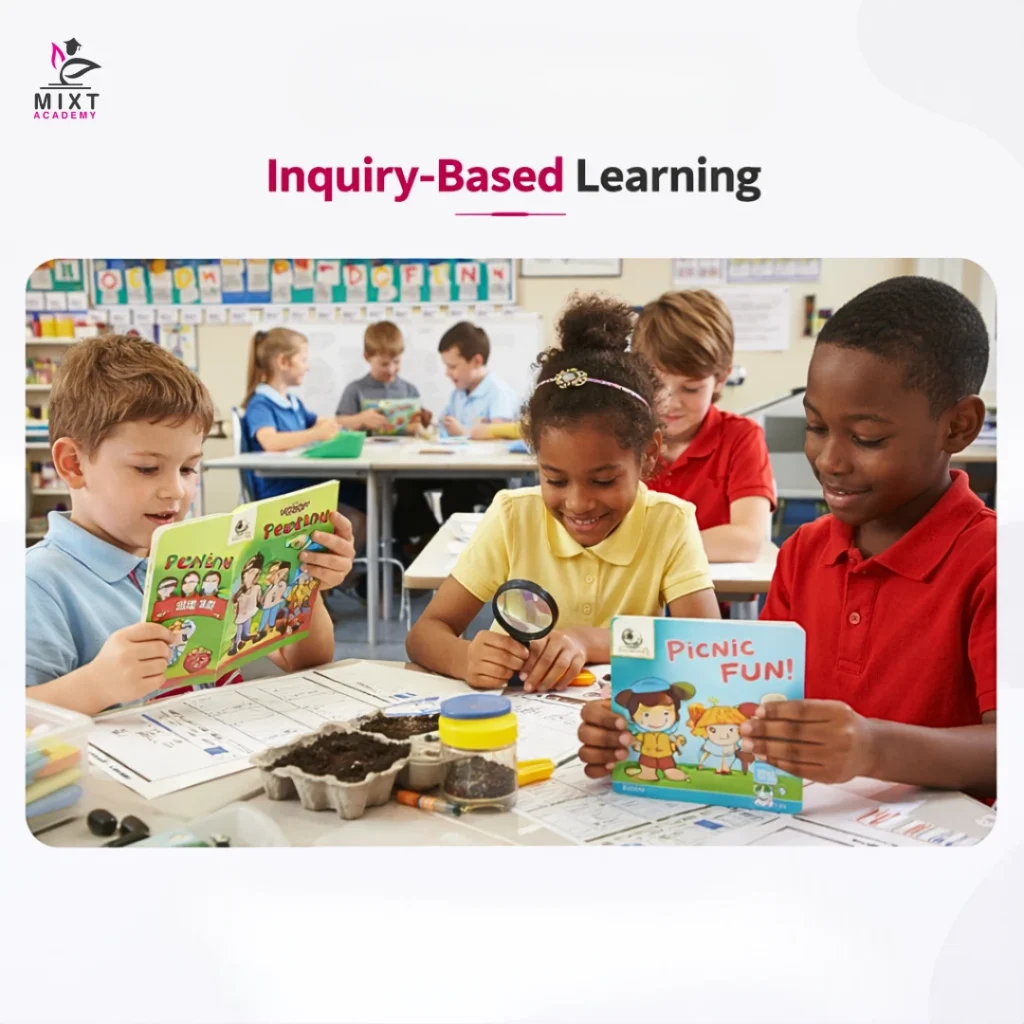
The New Oxford Modern English series builds strong language skills at primary and lower secondary levels, while the Oxford International Curriculum provides holistic inquiry-based learning for ages 2–19.
3. Teaching Approach
Cambridge: Cambridge encourages learner-centred, inquiry-based learning. It develops critical thinking and problem-solving skills while allowing schools flexibility in subject combinations.
Oxford: Combines phonics with whole-word recognition, a spiral curriculum, and active learning techniques to strengthen listening, reading, writing, speaking, and practical application of knowledge in all subjects.
4. Assessment & Progression
Cambridge: Provides a globally recognised assessment system with both formative and summative exams conducted in June and November, designed to prepare students for higher education and international careers.
Oxford: Uses continuous formative assessments, digital progress tracking, project evaluations, and summative end-of-year tests to ensure students develop academic skills and are ready for International GCSEs and A-levels.
5. Subject Coverage
Cambridge: Offers over 70 subjects across sciences, humanities, social sciences, languages, and mathematics, allowing students to explore diverse areas and tailor their studies to future academic or career goals.
Oxford: Provides core academic subjects including English, Mathematics, Science, and Computing, along with specialised areas such as Wellbeing, Global Skills Projects, and Sustainability to foster holistic development.
6. City & Learning Environment
Cambridge: A picturesque, intimate city with a traditional, quiet atmosphere, riverside beauty, and multidisciplinary learning opportunities that provide students with a calm, focused environment for study.
Oxford: A lively, historic city featuring iconic landmarks, extensive libraries, museums, and a vibrant student culture, offering a stimulating and inspiring environment for both academic and personal growth.
Achieve Academic Success with Trusted Online Tutors!
Looking for expert guidance to choose the right academic path? Mixt Academy connects you with certified tutors across all levels, from foundational to advanced studies, covering a variety of curricula. Whether your child needs personalised academic support or help improving a specific subject, our experienced tutors are here to help.
Moreover, our experienced tutors provide guidance on selecting the most suitable syllabus and tailored strategies to ensure success. Book a free demo today and let Mixt Academy help your child build confidence, excel academically, and reach their full potential.
Choosing Between Cambridge vs Oxford

Choosing between Cambridge and Oxford ultimately depends on your child’s academic interests, preferred learning style, and the environment in which they thrive best. Both universities provide world-class education and global opportunities across the humanities, sciences, and interdisciplinary studies.
Both universities offer some flexible and part-time postgraduate options; however, most undergraduate programs remain campus-based.