

“Which one should I choose?” is a common question among students and parents entering the international education sector, especially when considering the Cambridge and Edexcel examination routes. Both boards are highly regarded, offering IGCSE and A Level qualifications recognised worldwide and providing access to top universities and career opportunities. While both originate from the UK, they differ in teaching methods, assessment styles, grading systems, and subject flexibility.
From a student’s perspective, differences between the two boards can affect their academic pathways and learning experiences. Parents and educators also reflect on how each board aligns with a student’s strengths, whether it is the more traditional, exam-based Cambridge or the more modular and versatile Edexcel coursework structure. In this guide, we will discuss the key similarities and differences between the two boards, evaluate the benefits and challenges of each, and answer one of the most common questions: Which board is right for you?
Still Unsure Whether Cambridge or Edexcel Is Better for Your Child?
Our academic advisors help students choose the right board based on their strengths and university goals.
What is the Pearson Edexcel Exam?
Pearson Edexcel offers international GCSE and A Level examinations and is part of Pearson Education, the world’s largest education company. These exams are recognised in the UK and most Commonwealth countries. Edexcel combines academic rigor with practical assessment, focusing on real-world applications. Examinations are modular and include written papers, coursework, and practical assessments, making them suitable for higher education, vocational training, and employment pathways.
What is Cambridge International Examinations?
Cambridge International Examinations (CIE), founded in 1858, is the world’s largest international education provider. Operating in over 160 countries, CIE focuses on higher-level critical thinking and conceptual understanding. Most Cambridge International Schools use CIE syllabi, which are widely recognised by universities worldwide.
Key Differences Between Edexcel vs Cambridge Exams
For many subjects, CIE utilises tiered exam systems in which students are offered Foundation and Higher-level exams. In contrast, Edexcel uses a single set of examination papers for most subjects, including math. Let’s examine this more closely.
| Particulars | Pearson Edexcel | Cambridge (CIE) |
|---|---|---|
| Exam Structure | Modular and linear options. | Primarily linear. |
| Assessment | A combo of coursework, practicals, and exams. | Mostly final exams. |
| Difficulties | It is slightly more accessible in a few subjects. | It is academically more rigorous overall. |
| Resources | Textbooks and guides by Pearson. | Wide range of third-party resources. |
| Flexibility | More modular choices are available. | Fixed syllabus, less modularity. |
| Ideal Student | Learners need a balance of assessment styles. | Academically inclined, exam-focused. |
| Student Experience | Balanced workload. | Intense and exam-centric. |
| Learning Structure | Real-world application, skills-oriented. | Deep conceptual understanding. |
| Curriculum Focus/Breadth | Slightly narrower but practical. | Broad and detailed. |
| Global recognition | Highly recognised globally. | Universally recognised and prestigious. |
Confused by Grading, Difficulty, and Exam Structure Differences?
Talk to a subject expert and get personalised advice.
1. Exam Structure
CIE uses tiered exams: Foundation and Higher-level papers for many subjects. Edexcel uses tiered exams only for mathematics; other subjects have a single exam paper with mixed difficulty. Exam sessions also differ:
- CIE: June and November
- Edexcel: June, October, and January
CIE is considered more challenging, with a stronger emphasis on higher-order application-based questions.
2. Assessment Style
Cambridge: Linear system—final exams at the end of the course, exam-heavy, promoting long-term learning and endurance.
Edexcel: Modular or linear system—exams can be taken in stages, with the possibility to retake modules. Includes coursework and practical assessments in some subjects.
Need Help Deciding Which Exam Board Fits Your Learning Style?
Our expert tutors at Mixt Academy specialise in both Cambridge and Edexcel curricula and can guide you step by step.
3. Difficulties
Edexcel is generally perceived as less difficult. Cambridge requires consistent study, problem-solving, and critical thinking for success.
4. Resources
Edexcel provides abundant study materials via Pearson. Cambridge materials are available but scattered across multiple publishers.
5. Academic Approach
Cambridge: Focuses on critical thinking, deep analysis, problem-solving, and research skills. Ideal for top-tier university preparation.
Edexcel: Encourages progressive learning, continuous assessment, and hands-on skills. Suitable for students benefiting from flexible assessment.
6. Flexibility
Edexcel offers modular exams that can be retaken. Cambridge has limited flexibility with single final exams per course.
7. Ideal Student
- Edexcel: Suited for students preferring gradual assessment and multiple attempts.
- Cambridge: Suited for academically ambitious students who excel under rigorous exam conditions.
8. Grading System
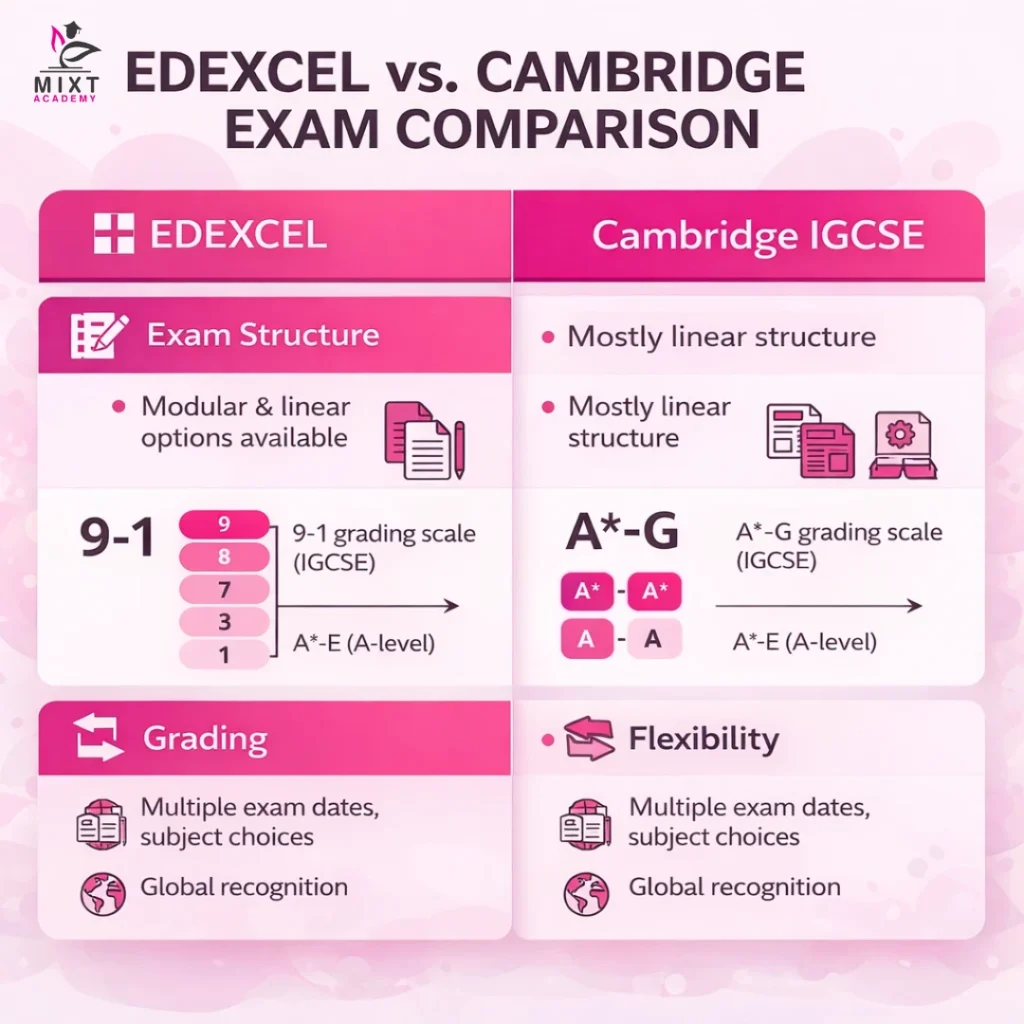
- Cambridge: IGCSE A–G, A Level A–E. Simple and widely understood.
- Edexcel: IGCSE A–G or 9–1 system, A Level A–E. Numerical grading differentiates high-achieving students.
9. Global Recognition
Both boards are recognised globally. Cambridge is considered the “gold standard” for top-tier university admission. Edexcel is also widely accepted, with flexible modular options.
10. Subject Range
- Cambridge: Over 70 IGCSE and 55 A Level subjects, offering extensive customisation.
- Edexcel: ~40 IGCSE and 20+ A Level subjects, including vocational options.
11. Learning Structure
Edexcel emphasizes practical, real-world scenarios. Cambridge focuses on theoretical, analytical learning to develop critical thinking and research skills.
Pros and Cons of Cambridge vs Edexcel
Cambridge (CAIE)
- Pros: Widely recognised; broad subject choices; excellent university preparation; promotes critical thinking; partnerships with universities.
- Cons: Stressful linear exams; fewer coursework opportunities; limited exam sessions; high final exam pressure.
Pearson Edexcel
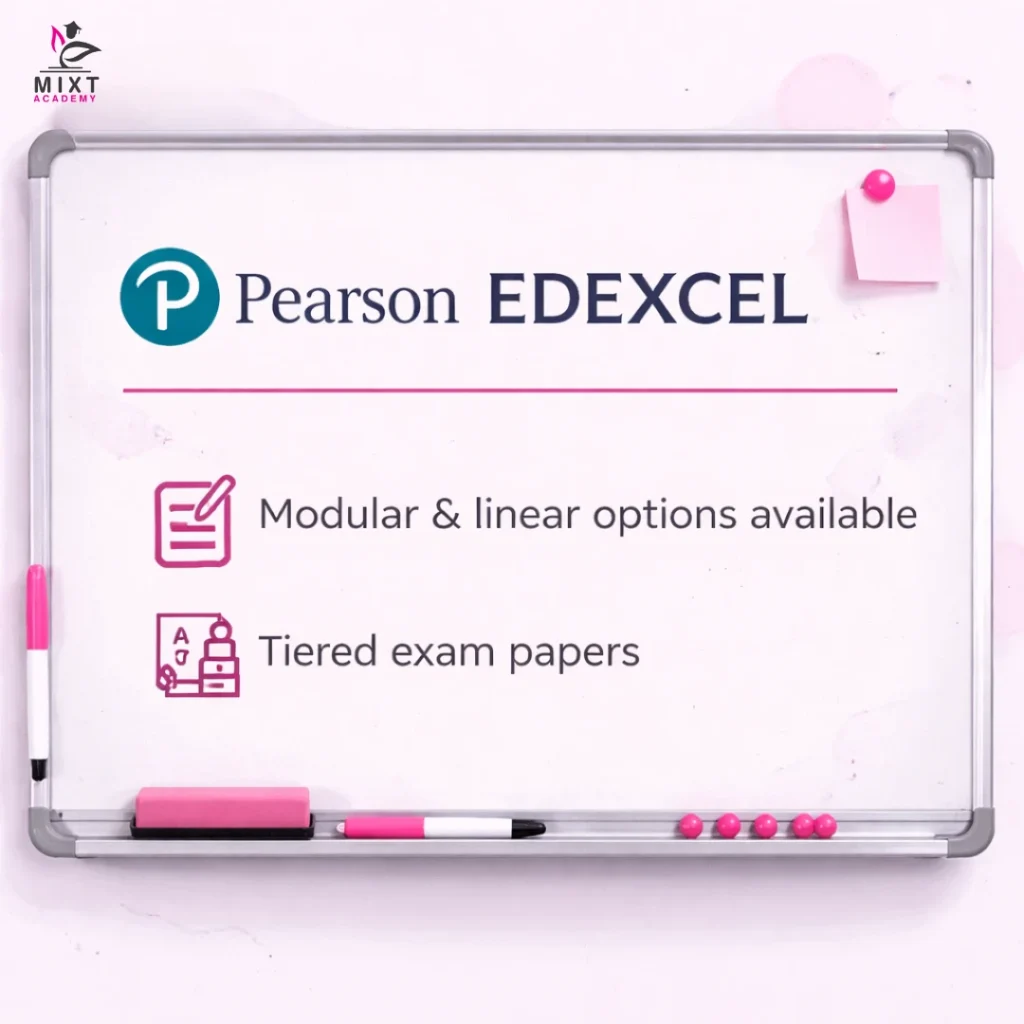
- Pros: Flexible modular exams; multiple exam sessions; step-by-step assessment; practical and vocational courses.
- Cons: Narrower subject selection; perceived as less challenging; modular system may encourage minimal effort in learning.
Choosing the Right Curriculum

Choosing between Cambridge and Edexcel depends on the student’s learning style, strengths, and academic goals. Cambridge suits students seeking analytical, independent, and research-driven challenges. Edexcel is ideal for students preferring structured, step-by-step learning with practical applications and flexible assessments. Success ultimately depends on a student’s determination and commitment to learning.