
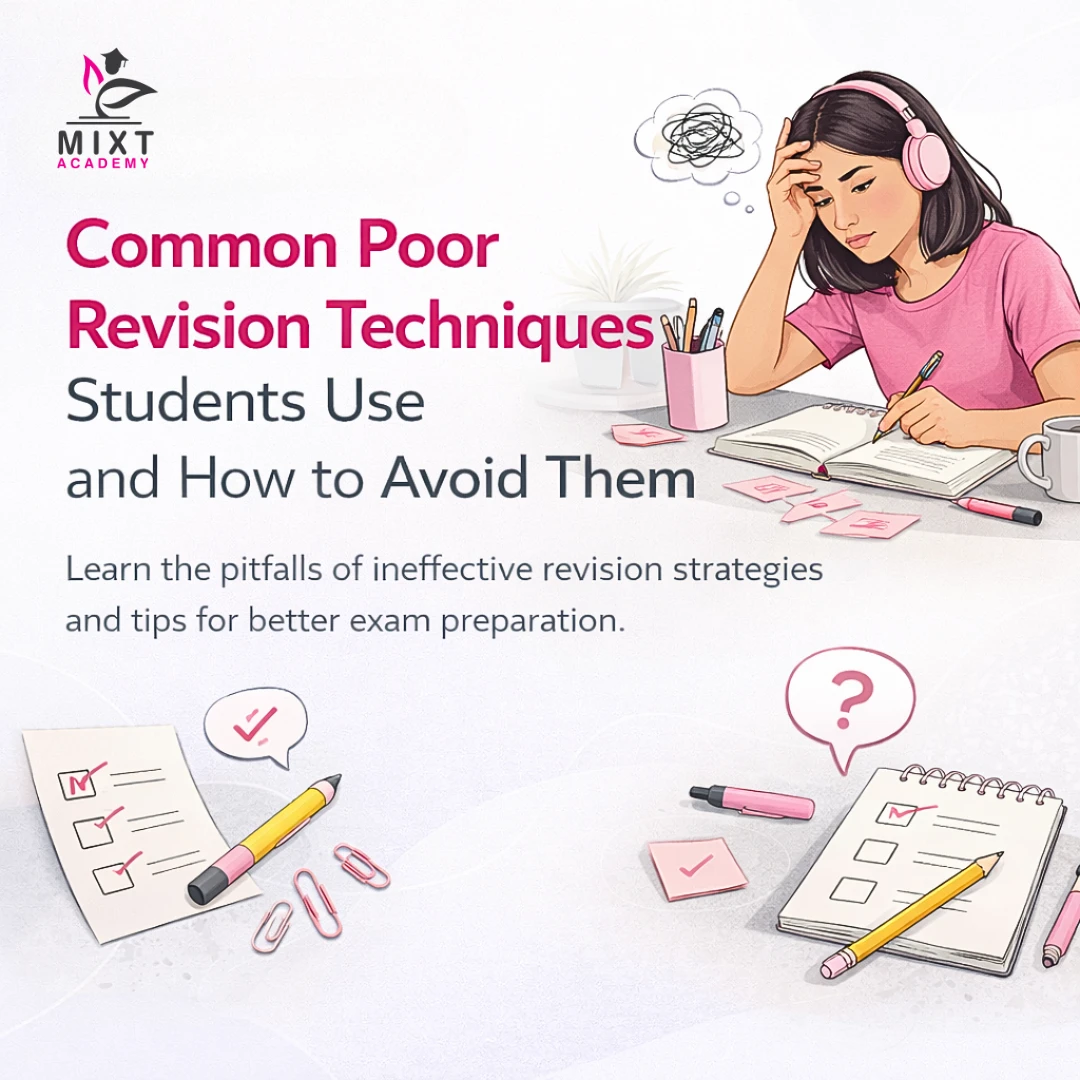
Social media trends and unqualified tutors spread misinformation about effective methods, leading to widespread misconceptions. Students need to learn evidence-based revision strategies from professional educators, as these are the most effective way to learn revision techniques. The instructional guide identifies which revision methods to avoid and which to use with caution, based on our experienced tutors’ guidance.
While these methods add value to learning, active recall and spaced practice deliver better results and should be the primary study methods. Let’s explore these poor revision techniques in detail and understand which revision methods truly boost learning and retention.
Unsure Which Revision Techniques Lead to Exam Success?
Join Mixt Academy today and ensure your grades from C to A&A*.
14 Poor Revision Techniques That Kill Exam Success
When preparing for exams, some of our habits can be more harmful than helpful. Here’s a checklist of 14 common revision pitfalls that you must avoid to ensure your success!
- Passive Reading
- Highlighting Everything
- Memorising Without Understanding
- Revising for Hours Without Breaks
- Revising Only Easy Topics
- Multitasking While Revising
- Skipping Active Recall
- Last-minute Cramming
- Revising Without a Plan
- Avoiding Weak Areas
- Over-relying on Notes
- Revising with Distractions
- Ignoring Past Papers
- Using Unqualified Tutors
1. Passive Reading During Revision
Simply rereading textbooks or notes is ineffective because it gives a false sense of understanding. Active engagement improves comprehension, retention, and enjoyment of learning. In contrast, passive reading does not enhance recall or problem-solving, so knowledge is quickly forgotten and revision becomes inefficient.
Solution of Passive Reading that Leads to Success
- Ask Questions: Challenge yourself to explain concepts and make connections.
- Summarise in Your Own Words: Write brief notes or diagrams to strengthen understanding.
- Discuss with Others: Study groups or peer discussions help clarify ideas and reveal gaps.
- Use self-testing: Quiz yourself on key points instead of just rereading.
2. Highlighting Every Topic of the Subject in Revision
Highlighting all the content in textbooks or notes defeats its purpose, because nothing stands out as important. This habit promotes passive rereading rather than active recall, making revision inefficient.
How to Revise Effectively Instead of Highlighting Everything?
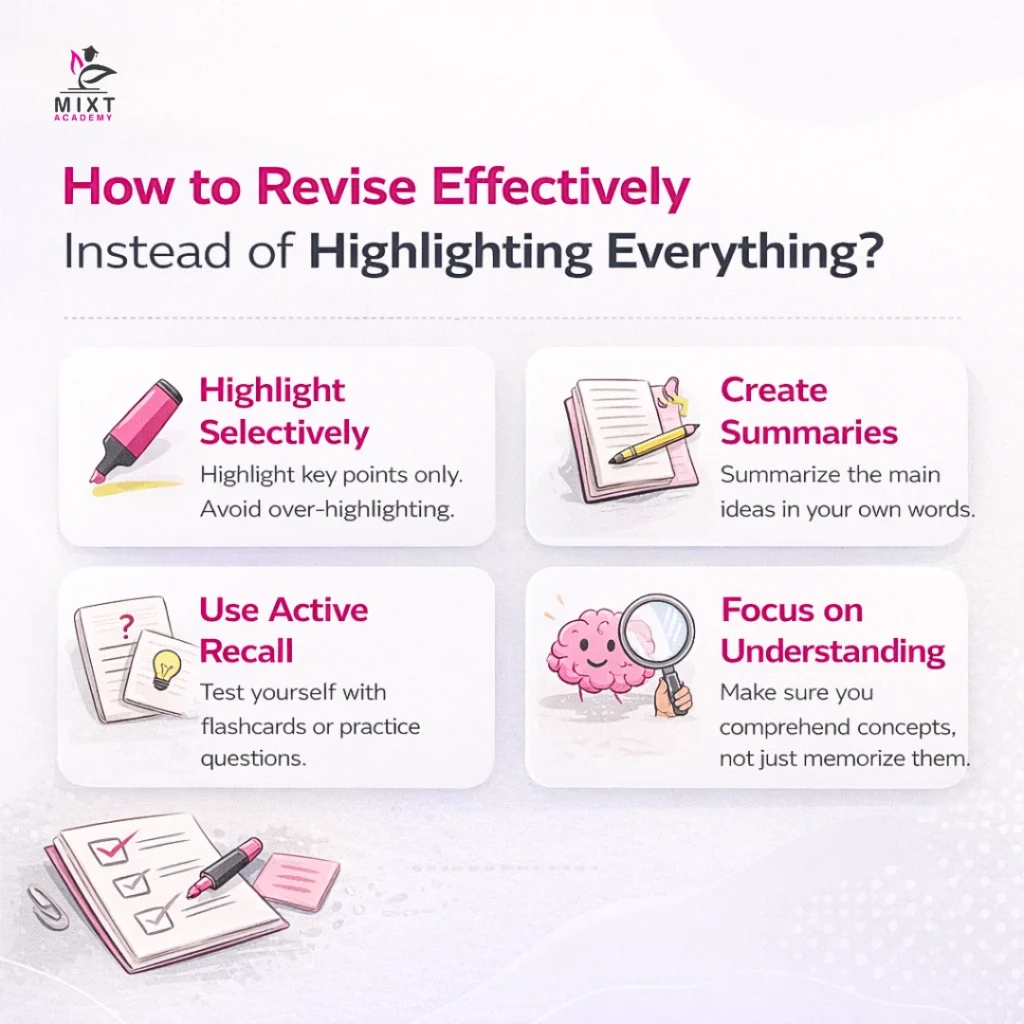
- Highlight Selectively: Only mark truly important ideas, not entire pages.
- Create Summaries: Convert highlighted points into your own notes or diagrams.
- Use Active Recall: Make questions from highlighted material and test yourself.
- Focus on Understanding: Review highlights to apply concepts, not just recognise them.
3. Memorising Without Understanding During Revision
Rote memorisation without understanding involves repeating facts or formulas without grasping their meaning or connections. This method hinders deep learning, weakens problem-solving and critical thinking, and increases exam stress because memorised material is easily forgotten.
Solution of Memorising During Revision
Active learning, such as explaining concepts in your own words, solving varied problems, or teaching the material to someone else, strengthens understanding, improves recall, and helps apply knowledge flexibly.
4. Revising for Hours Without Breaks in Revision
Studying for long hours without breaks overwhelms the brain, reduces concentration, and causes mental fatigue. Short, structured breaks are essential to restore focus and make study time more effective.
How to Revise Effectively with Breaks?
- Follow the Pomodoro technique: Study in focused blocks (25–50 minutes) followed by short 5–10 minute breaks.
- Schedule Longer Breaks: Include a 20–30 minute break after every 2–3 study sessions.
- Move and Stretch: Use breaks to stand, walk, or do light exercise to refresh your mind.
- Stay Hydrated and Eat Well: Proper nutrition supports focus and energy during revision.
- Plan Study Sessions: Break large topics into smaller, manageable chunks to maintain concentration.
Professional recommendations suggest study sessions of 30–45 minutes followed by a short break.
5. Revising Only Easy Topics
Focusing only on easy topics creates gaps in understanding and limits problem-solving skills.
How to Avoid Revising Only Easy Topics?
- Identify Weak Areas: List difficult topics and prioritise them.
- Mix Easy and Hard Topics: Alternate between familiar and challenging material.
- Set Specific Goals: Allocate time for difficult subjects and track progress.
- Use Active Learning: Practice problem-solving, self-quizzing, or teaching for challenging topics.
- Reward Effort: Acknowledge completing tough sections to stay motivated.
6. Multitasking While Exams Revising
Multitasking reduces focus, slows comprehension, lowers retention, and increases mistakes.
How to Avoid Multitasking While Revising?
- Create a Distraction-free Environment: Study in a quiet space, away from phones, social media, and TV.
- Turn Off Notifications: Silence phones or set them on airplane mode.
- Use Focused Study Blocks: Set specific time periods for single-task focus.
- Take Planned Breaks: Use breaks to check messages or social media.
- Set Clear Goals: Know exactly what to study in each session.
7. Skipping Active Recall During Revision
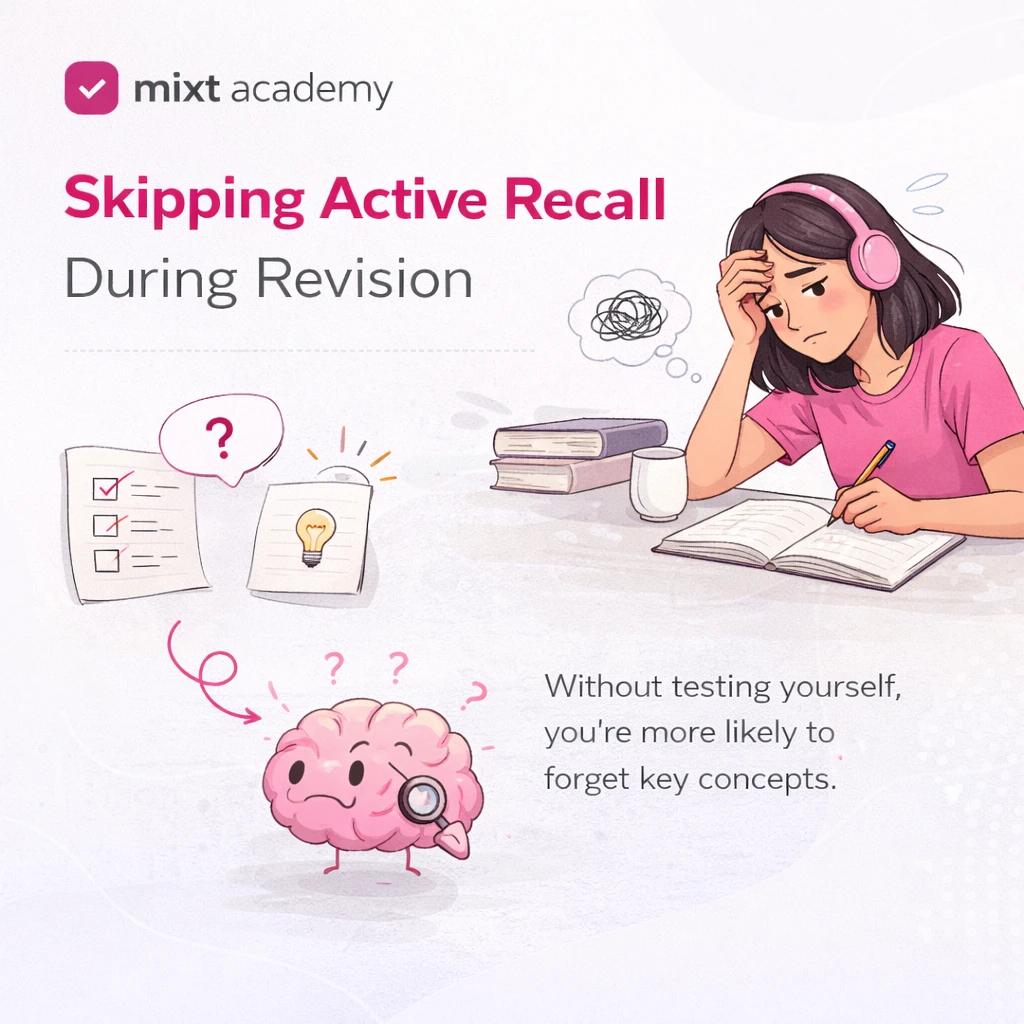
Neglecting active recall means passive review alone, which weakens long-term retention and problem-solving skills.
How to Avoid Skipping Active Recall During Revision?
- Self-quiz Regularly: Test yourself on key concepts.
- Use Flashcards: Practice recapture of concepts.
- Practice Past Papers: Apply knowledge to exam-style questions.
- Explain Aloud: Teach material to yourself or others.
- Summarise from Memory: Write down what you remember and check for gaps.
8. Topic Cramming the Night Before Exams
Cramming stresses the brain, reduces retention, disrupts sleep, and limits application ability.
How to Avoid Cramming the Night Before Exams?
- Start Early: Break the syllabus into manageable sections.
- Create a Study Schedule: Allocate daily or weekly goals.
- Use Active Recall: Regularly test yourself.
- Prioritise Sleep: Ensure 7–8 hours of rest.
- Review Strategically: Focus on understanding and applying key concepts.
9. Revising Without a Plan
Studying without a plan leads to inefficiency, random topic coverage, and increased stress.
How to Avoid Revising Without a Plan?
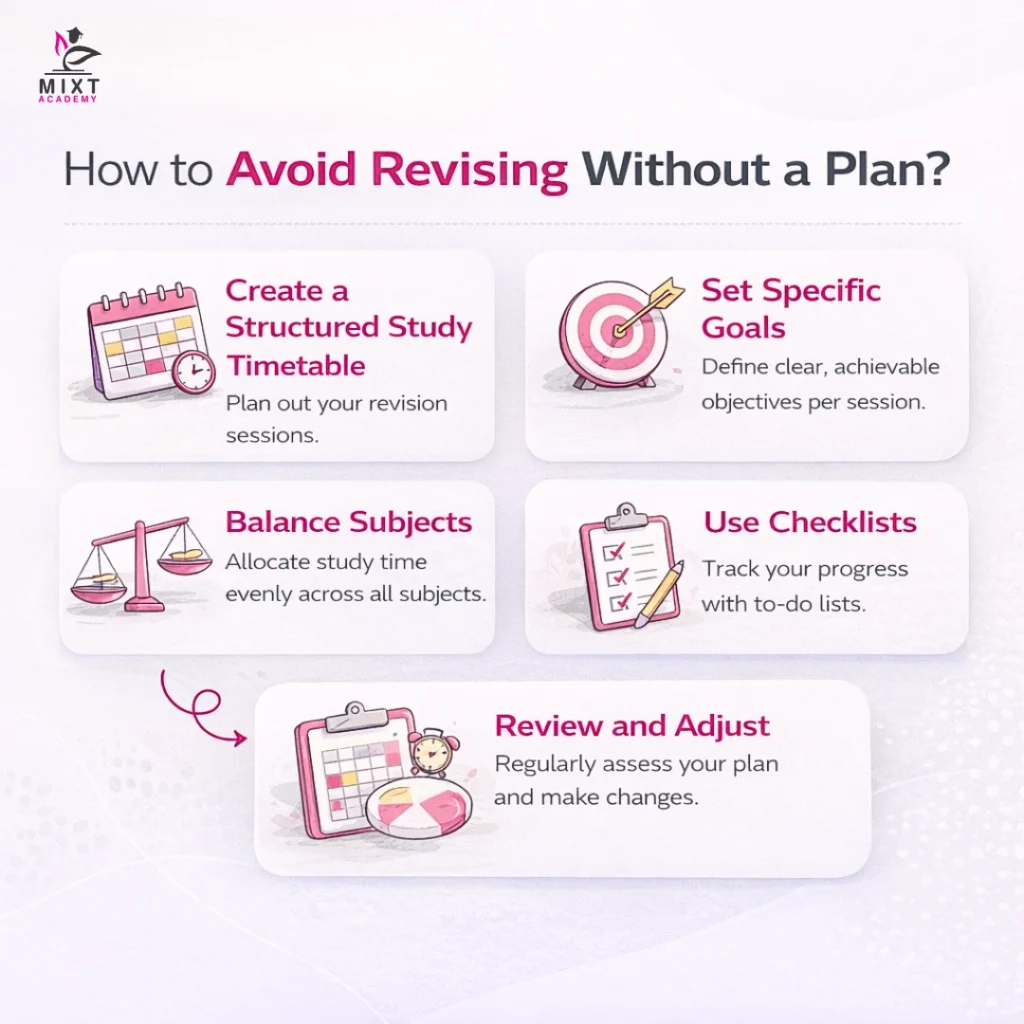
- Create a Structured Study Timetable: Break topics into daily or weekly sessions.
- Set Specific Goals: Define objectives for each session.
- Balance Subjects: Allocate time to strong and weak areas.
- Use Checklists: Track completed topics.
- Review and Adjust: Regularly refine the plan.
10. Avoiding Weak Areas During Revision
Ignoring weak subjects creates knowledge gaps and reduces exam performance.
How to Avoid Weak Areas During Revision?
- Identify Weak Topics Clearly: Rate topics on a 1–5 confidence scale and focus on 1–2.
- Prioritise Weak Areas First: Study low-confidence topics when energy is highest.
- Break Topics into Smaller Tasks: Make revision manageable.
- Use Active Revision Methods: Practice questions, flashcards, self-testing, teaching.
- Track Progress and Mistakes: Monitor improvement and update confidence ratings.
11. Over-relying on Notes During Revision
Relying solely on notes limits understanding, reduces critical thinking, and lowers exam performance.
How to Avoid Over-relying on Notes During Revision?
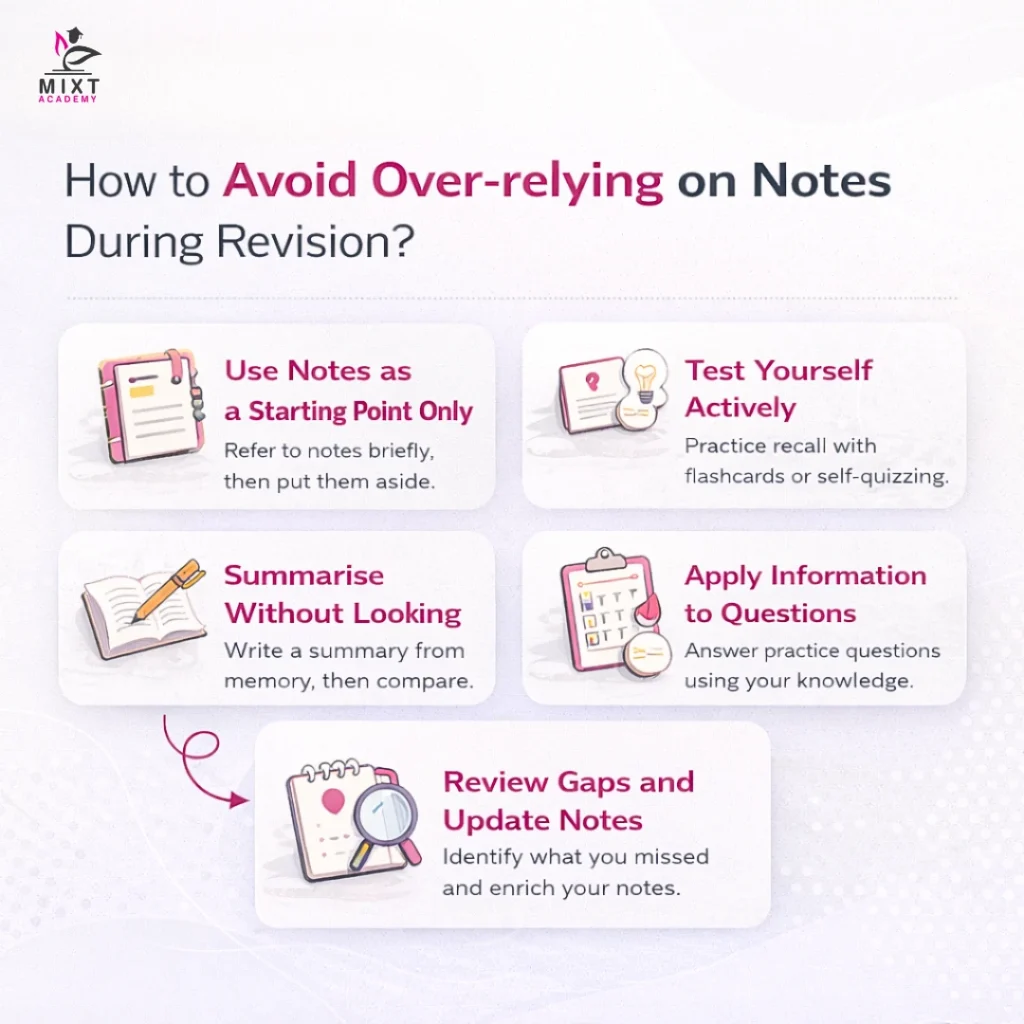
- Use Notes as a Starting Point Only: Read briefly then close them before practising.
- Test Yourself Actively: Self-quizzing and practice questions.
- Summarise Without Looking: Write summaries from memory.
- Apply Information to Questions: Practice past papers and exam-style questions.
- Review Gaps and Update Notes: Return only to clarify weak points.
Does Relying Solely on Notes or Revision Guides Limit Your Understanding?
Don’t Worry! Mixt Academy, a leading online tutoring platform, offers expert guidance and interactive lessons that help you fully grasp concepts, build problem-solving skills, and confidently tackle exams.
12. Studying in Distracting Environments During Revision
Noise, social media, TV, and interruptions split attention and reduce effectiveness.
How to Avoid Studying in Distracting Environments During Revision?
- Choose a Dedicated Study Space: Quiet, clutter-free, used only for revision.
- Remove Digital Distractions: Silence notifications and keep devices out of reach.
- Set Clear Study Time Blocks: Timed sessions with breaks.
- Control Background Noise: Use noise-cancelling headphones or white noise.
- Review and Adjust Environment: Make small changes to improve focus.
13. Not Practising Past Papers in Revision
Failing to practice past papers limits application, time management, and identification of weak areas.
How to Avoid Not Practising Past Papers in Revision?
- Schedule Past Papers Regularly: Include them in weekly revision.
- Start Topic-by-Topic: Build confidence gradually.
- Practise Under Timed Conditions: Simulate exam timing.
- Analyse Mistakes Carefully: Review mark schemes.
- Track Performance Over Time: Record scores and mistakes to refine focus.
14. Using Unprofessional or Unqualified Tutors
Unqualified tutors may provide incorrect guidance, waste resources, reduce confidence, and encourage bad habits.
How to Avoid Using Unprofessional or Unqualified Tutors?
- Check Qualifications and Experience: Ensure relevant knowledge and certifications.
- Review Track Records and Feedback: Look for testimonials and success stories.
- Assess Teaching Methods: Tutors should explain clearly and adapt to learning styles.
- Set Clear Expectations: Agree on goals, lesson structure, and progress checks.
- Evaluate Progress Regularly: Monitor improvement and change tutors if needed.
Say Goodbye to Poor Revision Habits Today
Tired of wasting hours on ineffective revision methods? Stop passive reading, last-minute cramming, and confusing notes. At Mixt Academy, our expert tutors guide you with proven strategies, active recall, and exam-focused practice, so every study session counts. Learn smarter, not harder, and strengthen weak areas while building confidence. Transform your approach to learning and achieve better results with structured, professional guidance.
How Can Students Avoid Common Revision Mistakes?
Effective revision requires strategy. Poor techniques, like passive reading, cramming, over-highlighting, and ignoring weak areas, limit understanding. Students benefit most from active methods such as spaced practice, active recall, similar techniques, and past papers. Planning study sessions, focusing on weaker topics, and creating meaningful memory relationships enhances learning efficiency. Avoid ineffective habits and adopt evidence-based approaches to consistently improve comprehension, strengthen recall, and achieve better exam performance.