
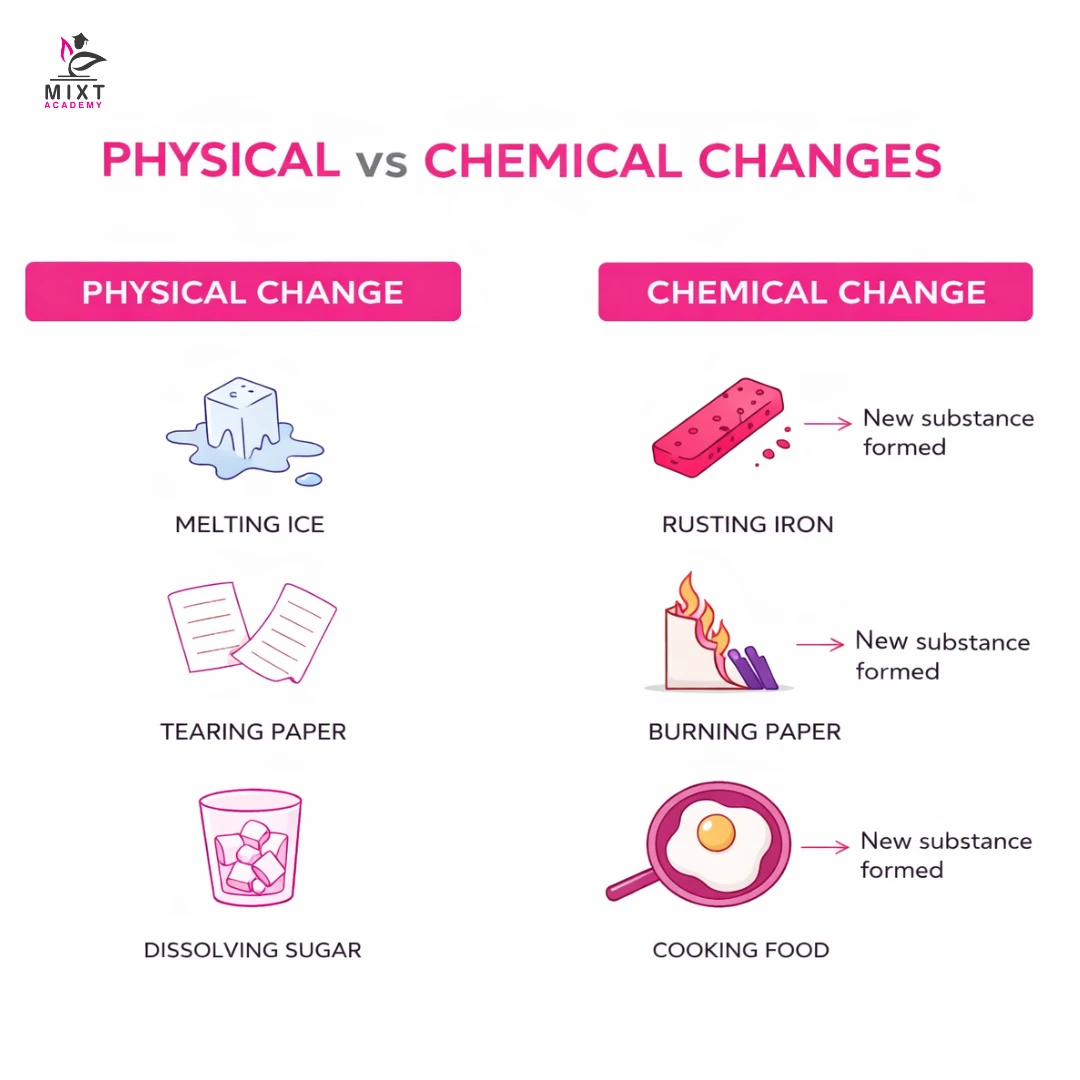
One of the basic principles of studying chemistry is learning how matter changes. Changes in matter occur every day in the surrounding environments. Melting ice, food cooking and iron rusting are all observable changes in matter. In chemistry, these changes are simplified into two categories: Physical changes vs Chemical changes. This serves as the basis for more complex chemistry principles and is relevant to students learning the difference between physical and chemical changes in class 9.
In this article, you will learn what a physical change is, what a chemical change is, physical vs chemical changes examples, common differences between them, along with key characteristics and identification methods.
Understanding Changes in Matter
A change reflects the alteration in shape, size, colour, state, or chemical makeup of matter. Changes can be classified into two categories based on new substance formation:
- Physical change
- Chemical change
It is essential to understand the concepts of physical and chemical changes to successfully answer questions in chemistry and apply these concepts to real life.
What is Physical Change?
A physical change is defined as a change where the only aspects which are modified are the physical characteristics of the substance, and the chemical structure of the substance stays the same.
Characteristics of Physical Change
- No new substance is formed
- Only physical properties change
- Usually reversible
- Chemical structure remains the same
Physical Change Examples
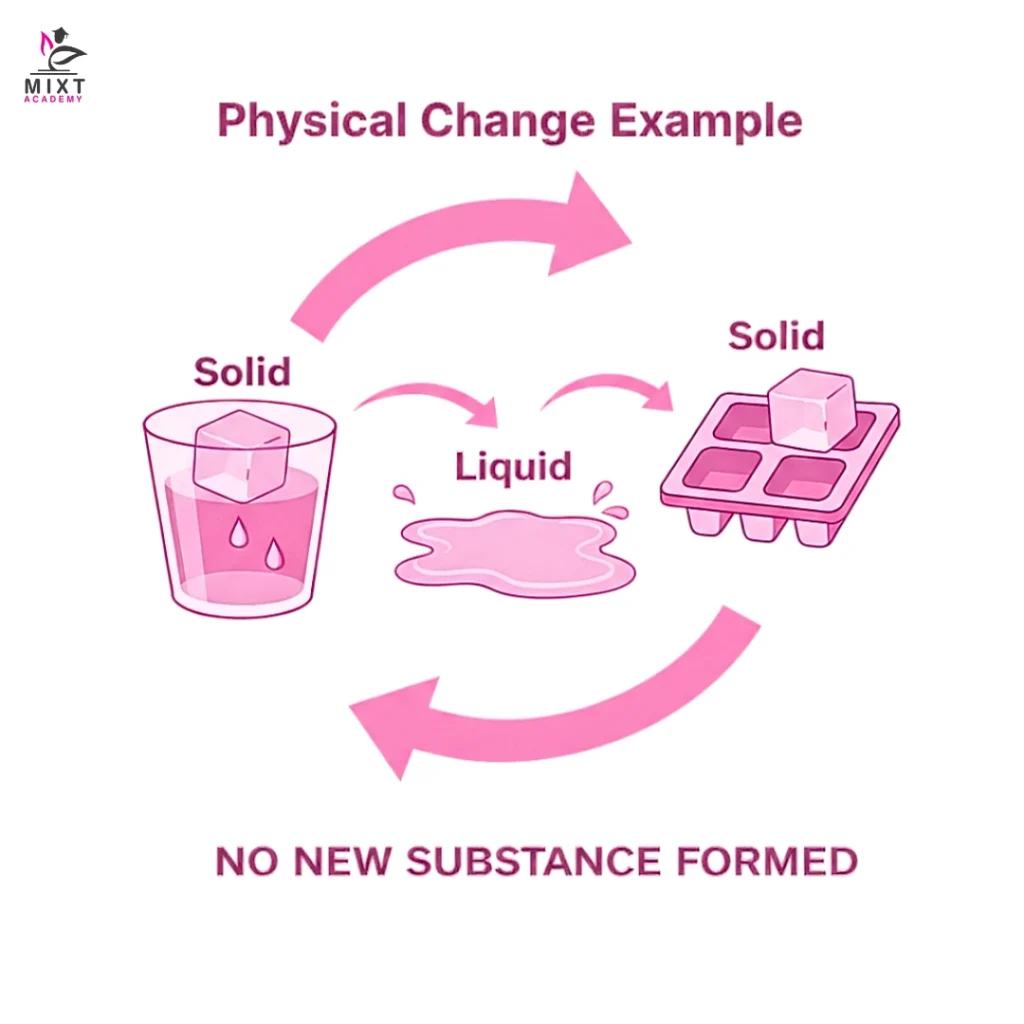
- Melting of ice into water
- Freezing of water
- Cutting or tearing paper
- Breaking glass
- Dissolving sugar in water
These common physical change examples highlight that matter may look different, but its chemical nature does not change.
What is Chemical Change?
A chemical change is a process in which the formation of one or more new substances takes place because of a change in the chemical composition of the substances involved. Chemical changes occur because of the breaking and new formation of chemical bonds. The new resulting substances will have completely different sets of properties from the original materials.
Characteristics of Chemical Change
- New substance is always formed
- Chemical composition changes
- Usually irreversible
- Energy is absorbed or released
- Permanent change in nature
Chemical Change Examples
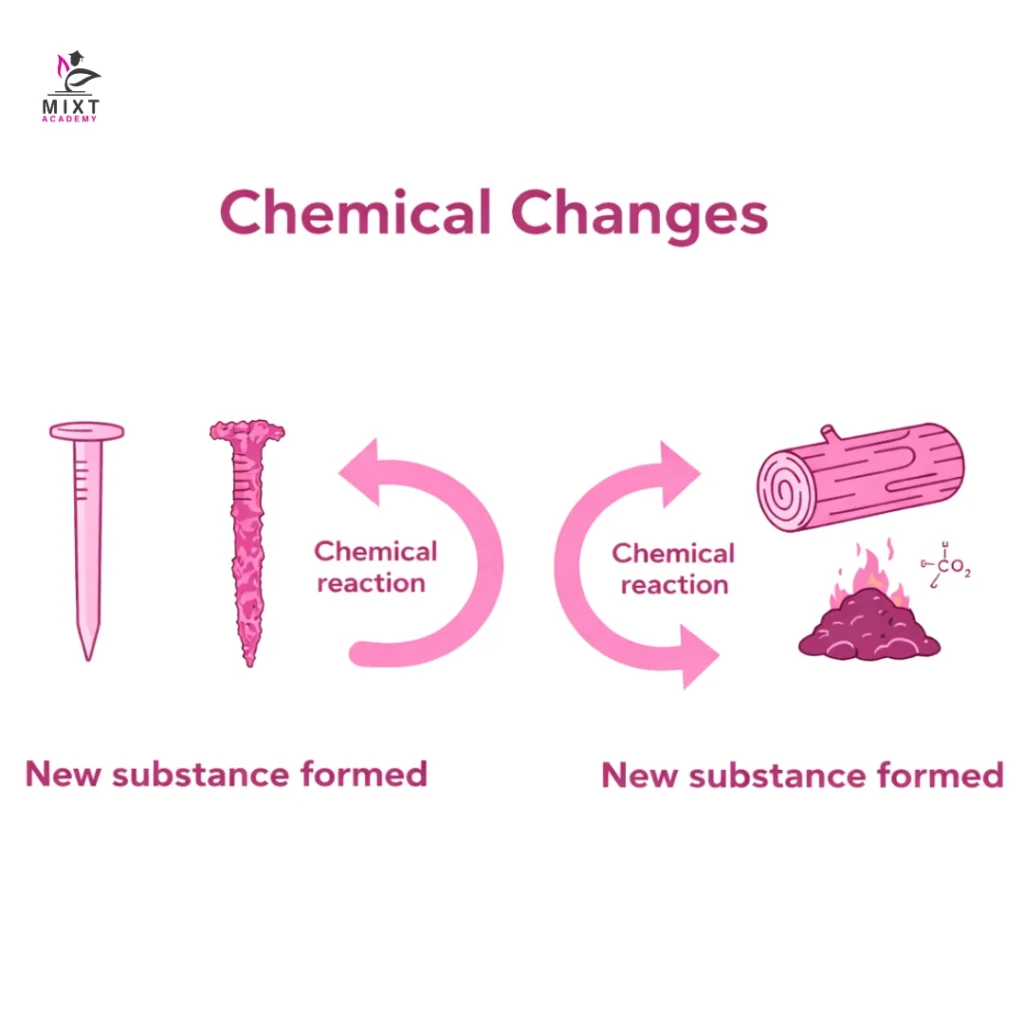
- Rusting of iron
- Burning of wood or paper
- Cooking food
- Formation of curd from milk
- Digestion of food
These chemical change examples clearly show the formation of new substances.
Common Differences Between Physical and Chemical Change
| Basis | Physical Change | Chemical Change |
|---|---|---|
| Nature | Change in physical properties | Change in chemical composition |
| New substance | Not formed | Always formed |
| Reversibility | Usually reversible | Mostly irreversible |
| Energy change | Very little or none | Significant energy change |
| Example | Melting ice | Burning wood |
These 5 differences between physical and chemical change are frequently tested in school examinations.
Difference Between Physical and Chemical Change Class 9
To class 9 students, this topic is a central part of the Chemistry syllabus. Important points to note for the examinations are:
- Physical changes do not complete the process by producing new substances
- Chemical changes involve chemical reactions
- Physical changes affect appearance only
- Chemical changes alter molecular structure
Students are often asked to:
- Define both changes
- Write differences in tabular form
- Identify changes from given examples
How to Identify the Type of Change?
To determine whether a change is physical or chemical, consider the following:
- Is a new substance formed? → Chemical change
- Is the change easily reversible? → Physical change
- Is heat, gas, light, or smell produced? → Chemical change
- Is it only the shape or the state changing? → Physical change
These simple checks help avoid common conceptual errors.
Confused About Differentiating Physical and Chemical Changes?
Get step-by-step explanations with real-life examples from expert tutors.
Why Choose Mixt Academy for Chemistry Learning?

Mixt Academy’s online Chemistry tutoring is designed to bridge learning gaps through personalised instruction. Students receive:
- Customised lesson plans aligned with their curriculum
- Step-by-step visual breakdowns on complex chemistry topics
- Practice worksheets with guided solutions
- Ongoing feedback and monitoring
This approach ensures that students not only learn the difference between physical and chemical change in class 9, but also develop a long-term understanding required for higher classes. Learn more at: https://mixtacademy.com/
Struggling to Memorise the Difference Between Physical and Chemical Change Class 9?
Practice structured notes and comparison charts with guided help.
Common Student Misconceptions
The most reliable way to identify a chemical change is to understand how new substances are formed.
- All irreversible changes are chemical (not always true)
- Dissolving sugar is a chemical change (No,it is a physical change)
- Colour change always indicates a chemical reaction (not necessarily)
Unable to Solve Chemistry Questions Confidently?
Access worksheets, doubt-solving sessions, and exam-focused mentoring.
Understanding Physical vs Chemical Changes
To understand the fundamentals of chemistry, students must analyse the concept of Physical vs Chemical Changes. Chemical changes are when new substances are formed, and physical changes are simply changes in state or appearance. As long as students understand the characteristics of physical vs chemical changes examples, they will confidently answer exam questions and utilise the knowledge in real-life scenarios. With the support of expert Chemistry tutors, conceptual breakdown, and structured guidance from Mixt Academy, the mastery of chemistry is made practical, logical, and simple.