
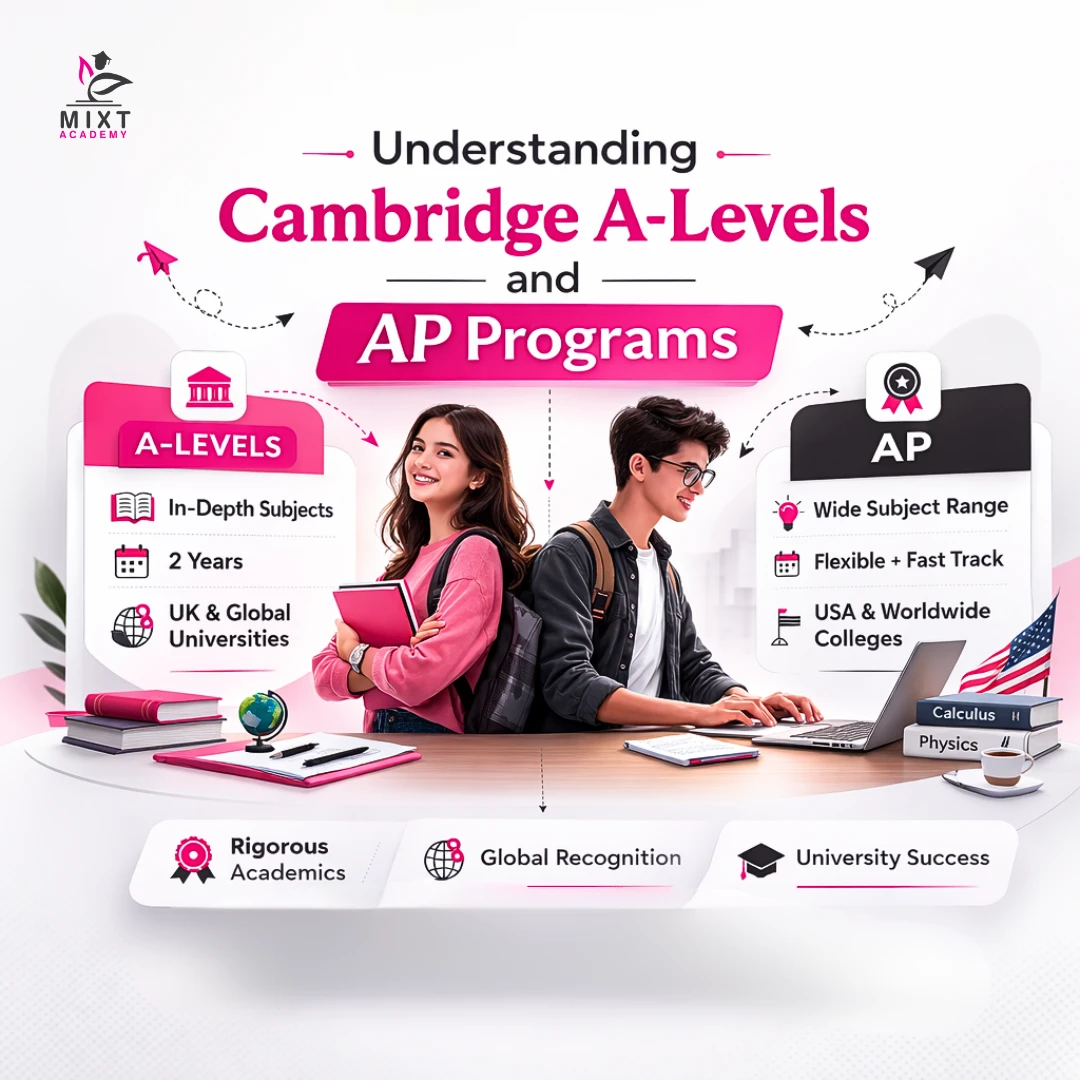
The academic pathways of Cambridge International Education (CIE) and Advanced Placement (AP) provide high school students with opportunities to study university-level courses, which enhance their college applications. Students in both programs encounter challenging academic material, but the programs present different methods of operation.
- The Cambridge course system enables students to study specific subjects through dedicated two-year programs, which develop their deep analytical understanding and expertise in particular fields.
- In contrast, AP courses allow students to complete their studies within a single year while studying multiple subjects.
Cambridge qualifications receive global recognition, whereas US universities mainly accept AP credentials. Mixt Academy professional tutors, with their extensive teaching experience, explain both programs in simple terms to help students learn more effectively.
What is Cambridge International Education (CIE)?
Cambridge International Education (CIE) is an international educational organization operating under the University of Cambridge. The organisation provides students aged 5 to 19 with internationally accredited academic programs and qualifications recognized in more than 160 countries.
The program aims to develop students into responsible global citizens who will succeed in their future studies and professional careers.
Cambridge Pathway (Programme Structure)
1. Early Years (ages 3–6)
- Play-based and Inquiry-Driven Learning: Encourages young learners to explore their environment, ask questions, and develop communication and social skills.
- Focus on Foundational Skills and Curiosity: Builds literacy, numeracy, motor, and interpersonal skills while nurturing curiosity.
2. Primary (ages 5–11)
- Core Academic Subjects: English, Mathematics, and Science build strong knowledge foundations.
- Essential Skill Development: Strengthens literacy, numeracy, and critical thinking skills.
3. Lower Secondary (ages 11–14)
- Builds Subject Depth: Expands understanding through structured content and conceptual learning.
- Analytical Skills: Teaches students to assess evidence and develop logical reasoning.
4. Upper Secondary – IGCSE (ages 14–16)
- IGCSE Qualification: Provides a globally recognized academic certification.
- Wide Subject Choice: Offers over 70 subjects including sciences, humanities, and creative fields.
- Flexible Combinations: Allows customized subject selection based on interests and career goals.
5. Advanced – International AS & A Level (ages 16–19)
- Specialised Subject Study: Promotes academic mastery and research skills.
- University Preparation: Develops advanced analytical and evaluation skills.
Academic Focus of the Cambridge Curriculum
- Subject Knowledge: Builds a strong academic foundation.
- Conceptual Understanding: Encourages deep learning beyond memorization.
- Higher-order Thinking: Promotes critical and analytical thinking.
- Independent Learning: Develops research and self-study skills.
- Global Perspectives: Encourages awareness of global issues and cultures.
Worldwide Recognition of Cambridge Qualifications
- Global Acceptance: Recognized by over 6,000 universities and employers worldwide.
- Academic Rigour: Known for challenging and in-depth curriculum.
- University Preparation: Prepares students for competitive higher education.
Cambridge Assessment and Examination System
- Standardised Exams: Ensures consistent global evaluation standards.
- Exam Schedule: Conducted in June and November each year.
- Assessment Methods: Includes written exams, coursework, and practical assessments.
Want to achieve top grades in your June or November exams this year?
Enrol with Mixt Academy, the reliable online tutoring platform offering qualified tutors, comprehensive notes, and proven strategies to excel in your exams.
What Is the Advanced Placement (AP) Program?
The Advanced Placement (AP) Program is an academically rigorous program run by the College Board in the United States. It allows high school students (usually ages 14–19) to take college-level courses and exams while still in school.
AP courses are widely recognised by colleges and universities in the U.S. and internationally, offering students the opportunity to earn college credit, strengthen university applications, and develop critical skills for higher education.
AP Program Structure
AP courses are typically one-year courses taken in high school’s junior or senior years. Students can choose from a broad range of subjects depending on their interests and academic goals:
1. Course Selection (ages 14–19)
- Wide Subject Variety: Students can choose from over 38 AP subjects, including sciences, mathematics, humanities, languages, and arts.
- Flexible Learning Path: Students can take as many or as few AP courses as they can manage, based on their strengths and goals.
2. Curriculum Focus
- College-Level Learning: AP courses provide in-depth coverage similar to first-year university courses.
- Analytical Skills Development: Emphasises critical thinking, problem-solving, and data analysis.
- Independent Study: Encourages time management, research skills, and self-directed learning.
3. Examination and Assessment
- AP Exams: Standardised exams are held annually in May.
- Scoring System: Exams are scored on a scale of 1–5, with 3 or higher often earning college credit.
- Assessment Methods: Includes multiple-choice questions, essays, and practical problem-solving.
Academic Focus of the AP Program
- Subject Mastery: Builds deep understanding for university-level studies.
- Critical Thinking: Encourages analysis, evaluation, and application of knowledge.
- Problem-Solving Skills: Develops logical reasoning and creativity.
- Time Management and Independence: Promotes self-discipline and responsibility.
- College Readiness: Prepares students for academic expectations in higher education.
Global Recognition of AP Qualifications
- University Acceptance: Recognised by thousands of universities worldwide, especially in the U.S.
- Academic Rigour: Known for a challenging and demanding curriculum.
- College Preparedness: Develops advanced academic and analytical skills.
Why Should Students Choose AP Courses?

- Explore Advanced Subjects: Study college-level topics while in high school.
- Earn College Credit: High scores can reduce university tuition and workload.
- Strengthen University Applications: Demonstrates academic commitment and excellence.
- Develop Essential Skills: Builds critical thinking, research, and study skills.
Smart preparation
Prepare smart and achieve high AP scores this year with Mixt Academy’s trusted online tutoring and exam-focused guidance.
Which is Better for Your Child, Cambridge or AP?
Choosing between Cambridge (A-Levels) and AP (Advanced Placement) depends on your child’s learning style, academic strengths, and university goals. Both programs are rigorous, college-level courses widely recognised by universities, but they differ in structure, focus, and assessment methods.
Cambridge (A-Levels) offers a deeper, more specialised approach, focusing on analytical and research-based learning, ideal for students aiming for UK or international universities.
The AP program provides flexibility with a broader subject selection and is widely recognised in the U.S., making it suitable for students who prefer a faster-paced, subject-specific curriculum.
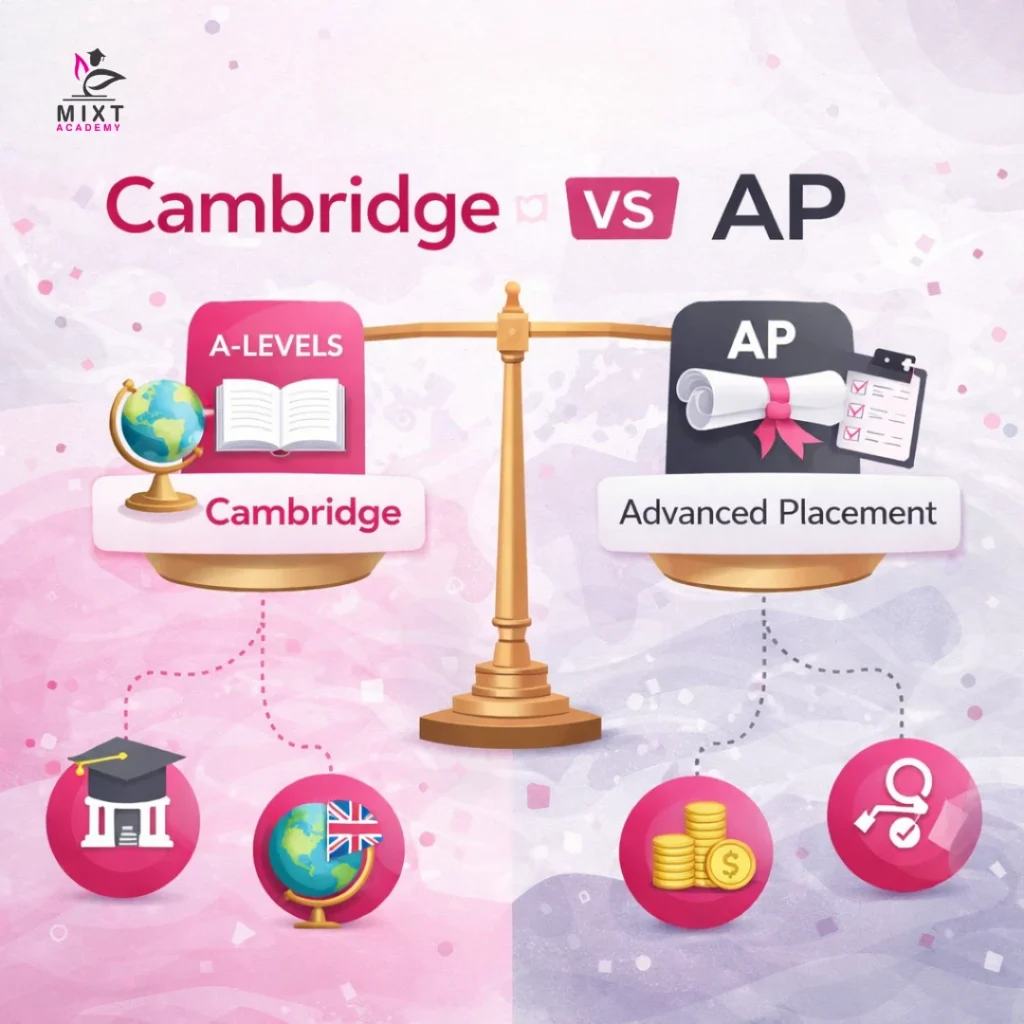
Core Considerations: Cambridge vs AP
University Destination
- Cambridge is often preferred by UK and international universities.
- AP is widely recognised by U.S. universities, though both programs have global acceptance.
Learning Style
- Cambridge focuses on in-depth, research-based learning and analytical thinking.
- AP courses are broader and faster-paced, allowing students to explore more subjects in one year.
Programme Structure
- Cambridge allows deep specialisation in a few subjects.
- AP allows flexible subject selection based on interest.
Assessment
- Cambridge relies mainly on structured final exams.
- AP includes multiple-choice and free-response questions, with potential college credit.
Still Deciding Which Academic Path to Choose for Your Child?
Both Cambridge and AP programmes are widely respected by universities and provide strong preparation for higher education. They help students develop critical thinking, research abilities, and essential academic skills for future success.
Choose Cambridge If
- University Destination: Your child plans to study in the UK or internationally.
- Focused Learning: Prefers deep study in 3–4 subjects over two years.
- Structured Pathway: Likes a consistent, linear curriculum.
Choose AP If
- University Destination: Plans to study in the U.S.
- Flexible Subject Choice: Wants to choose from a wide range of subjects.
- Fast-Paced Curriculum: Prefers a one-year, exam-focused approach.
Find the Right Program for Your Child with Trusted Online Academy
Choosing between Cambridge vs AP can feel overwhelming for parents and students alike. Both programs offer rigorous, university-level learning, but each has unique strengths depending on your child’s goals, learning style, and future university plans.
At Mixt Academy, our expert tutors guide students through both Cambridge A-Levels and AP courses, providing personalised lessons, exam-focused strategies, and proven study techniques. Whether your child thrives with specialised deep learning or a broader, flexible curriculum, we help them achieve confidence and top grades.
Take the guesswork out of your decision; book a certified online tutoring demo today and discover which program suits your child best.