
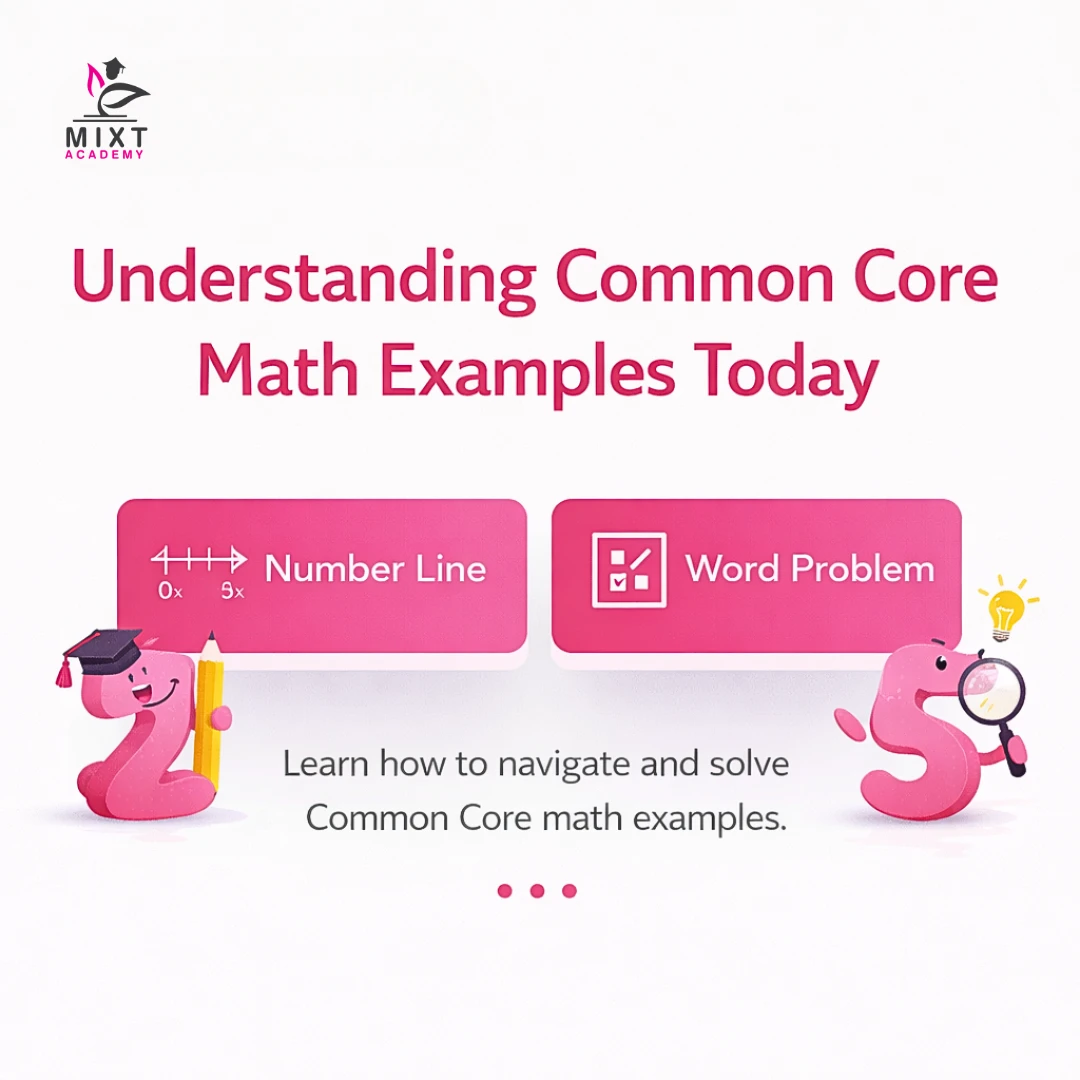
By the end of 2015, the majority of states had agreed to adopt common core, and many are still applying it today with slight modifications. Mixt Academy is in favour of common core by providing enjoyable and engaging math practice that is aligned with the standards.
Start Learning Common Core Math the Right Way
Get personalised lessons designed around how your child thinks, not just what they memorise.
What You Need to Know About Common Core Math?
The Interstate Mathematics and English Language Arts Common Core State Standards have been implemented to enhance the quality of math education all over the U.S. They highlight three primary objectives: making high school graduates ready for college or work, improving the general math performance of the students, and reducing the gap between state education standards.
Goals of the Common Core Math Standards
The eight standards for mathematical practice have been given centre stage in the Common Core Math. The standards that have been created by the teachers and researchers are founded on effective teaching practices, strong state programmes, and math models of international success. The standards help students to think critically, deal with problems, reason, and apply maths in real-life situations, and also promote accuracy and systematic work.
Practising these activities, in turn, makes the students acquire a better understanding of mathematics and also develop skills necessary for long-term academic success. While the Common Core specifies what students in each grade level are to learn, the schools and districts decide on the manner of teaching those standards.
Master Common Core Math Standards with Mixt Academy
Our online tutors help students become experts in Common Core math through personalised lessons tailored to each student’s learning style.
Is Common Core Math Making a Difference?
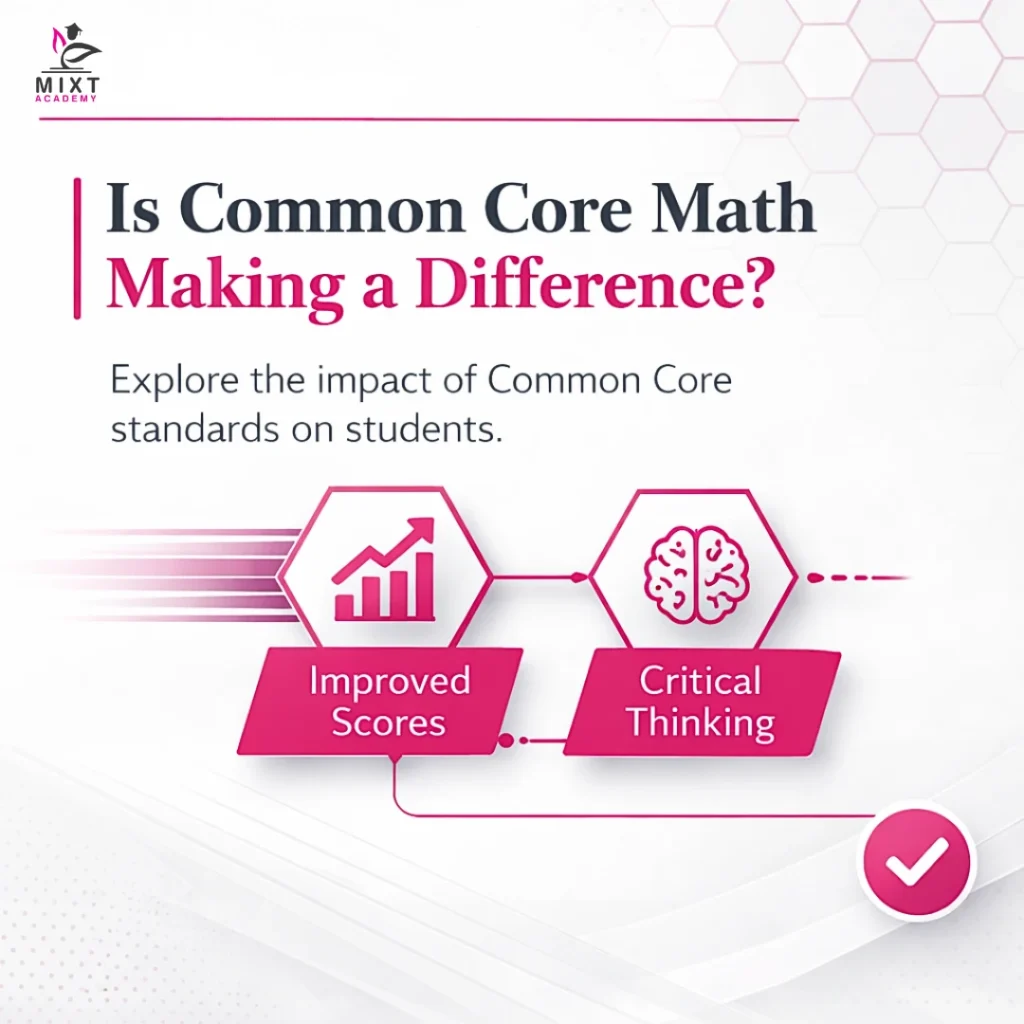
The transition from traditional methods to Common Core has guided teachers to make considerable changes in their teaching practices, and many of them are still in the process of adjusting. According to a study conducted by Harvard, it was found that 82% of maths teachers have changed over half of their teaching materials to meet the requirements of the new standards.
Additionally, the study indicated that 73% of the educators have “quite a bit” or “fully” accepted the standards, which is a sign of a wide acceptance of the standards, even though there are challenges.
1. Understand Problems and Solve Them
Students should take time for reflection because Common Core standard one requires them to investigate fundamental concepts that establish a problem. The practice of memorising formulas and procedures provides short-term advantages to students.
The open-ended questions enable students to understand mathematical concepts through their fundamental reasons, which exist beyond their technical methods of solution.
Example: Students were given a problem about sharing pizza slices among friends. Instead of being told a formula, they worked together to figure out how to divide the pizza fairly. They discussed different ideas, tested their solutions, and then shared their thinking with the class.
2. Reason Abstractly and Quantitatively
The second standard helps students understand numbers both as abstract symbols and in real-world situations. The first part includes two sections, which are below.
- Decontextualization: Students focus on the numbers and symbols in a problem without getting distracted by extra details.
Example: When students see the problem, “Alex has 7 apples, and Mia gives him 2 more. How many apples does Alex have?” they recognise it as 7 + 2 = 9, focusing on the math rather than the story.
- Contextualization: Students step back to see what the numbers mean in the real world.
Example: Students use blocks to model addition or measure classroom objects to find area or volume. This helps them connect abstract math concepts to practical, real-world situations.
3. Build Strong Arguments and Evaluate Others’ Thinking
This standard requires students to demonstrate their understanding through a step-by-step explanation of their thought process, which includes assessment of other people’s perspectives. Students achieve a better understanding of mathematical principles through their experience with data analysis and problem resolution, together with their strategic decision-making.
Example: Students work in small groups to solve a problem, with each student suggesting a solution. They explain how they arrived at their answers while classmates ask questions or offer different ideas. The teacher plays a supportive role, guiding the discussion only when needed and encouraging students to explain and defend their thinking.
Ready to Turn Confusion Into Confidence?
With personalised guidance, structured lessons, & expert support — your child won’t just improve, they’ll excel.
4. Apply Math to Real-World Situations
Students learn best when math connects to everyday life. This standard encourages using problems in practical ways, helping students see the relevance of math outside the classroom.
Example: Third-grade students made and sold bracelets to raise money for a local charity. They used math to figure out how much the materials cost, how much to charge for each bracelet, and how much money they earned. This activity helped students see how math is used in real life.
5. Choose and Use the Right Tools
With many tools available, like pencils, calculators, blocks, or online resources, students need to know which tool is best for each problem. This builds independence and problem-solving skills.
Example: At the beginning of a lesson, students decide which tools they will need and collect them. After completing the activity, the class discusses which tools were most helpful and explains why. This reflection encourages students to make thoughtful choices when solving problems.
6. Be Precise
Accuracy is key in math. Students should use correct symbols, define units clearly, and communicate their process. Precision early on creates a strong foundation for more advanced concepts.
Example: Students keep a math journal to record their learning. Younger students write or draw about what they did and learned, while older students explain their problem-solving steps, reflect on mistakes, and ask questions. Prompts such as “What was challenging?” or “How could you solve this differently next time?” help students think more deeply about their learning.
7. Recognise Patterns and Structure
Understanding patterns helps students tackle complex problems by breaking them into smaller, manageable parts. Recognising structure also increases speed and confidence in problem-solving.
Example: Daily math practice helps students notice patterns. Online tools like Prodigy make practice fun, and using manipulatives helps them visualise problems.
8. Use Repeated Reasoning
This standard focuses on learning from past problems to solve new ones. Students identify which elements stay the same and which vary, improving attention to detail and overall problem-solving.
Example: Students explore “fact families” by making several related equations from one problem. This helps them see number relationships and prepares them for topics like fractions, integers, and algebra.
Why Should We Learn Common Core Math?
Common Core math goes beyond memorising formulas, helping students think critically, solve problems, and connect math to real-world situations. Using Common Core math examples, students learn to recognise patterns, use tools effectively, and develop strong skills that support long-term success.
Teachers are enhancing lessons with Common Core math examples for grades 4, 5, and 6. These activities help students build confidence in reasoning, explain their thinking, and apply math to real-life situations.
Parents can support learning by exploring Common Core math examples with answers at home, staying informed, and encouraging curiosity. This creates a positive environment where students deepen their understanding and build the problem-solving skills the Common Core standards aim to teach.