
Understanding the power equation is a key step in mastering physics, as it explains how quickly work is done or energy is transferred in a system. This concept plays an essential role in topics ranging from mechanics to electricity and everyday technological applications.
At Mixt Academy, we simplify the power equation by breaking it into clear, easy-to-follow explanations supported by real-world examples. Whether you are a student preparing for exams or someone strengthening foundational physics knowledge, our approach makes learning both effective and engaging.
In this blog, you will learn the power equation in physics, how to apply it correctly, and why it matters, helping you build confidence and accuracy in problem-solving.
Definition of Power & Its Equation in Physics
Power functions in physics as a measurement system because it shows how fast work advances throughout time, which measures energy transfer. Power functions as a scalar quantity because it possesses size attributes but lacks directional components. The watt (W) serves as the primary power measurement unit because 1 watt equals 1 joule per second (J/s).
Fundamental Power Equations
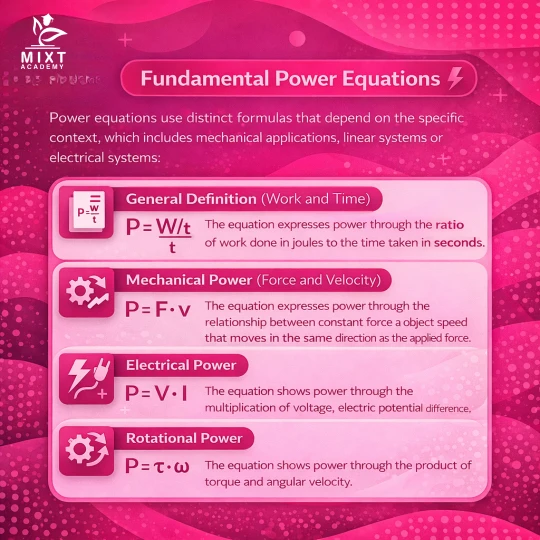
Alt: Fundamental power equations in physics covering work, mechanical, electrical, and rotational power
Power equations use distinct formulas that depend on the specific context, which includes mechanical applications, linear systems or electrical systems:
- General Definition (Work and Time): P=W/t The equation expresses power through the ratio of work done in joules to the time taken in seconds.
- Mechanical Power (Force and Velocity): P=F.v The equation expresses power through the relationship between constant force and object speed that moves in the same direction as the applied force.
- Electrical Power: P=V.I The equation shows power through the multiplication of voltage, electric potential difference, and electrical current.
- Rotational Power: 𝑃=𝜏⋅𝜔 The equation shows power through the product of torque and angular velocity.
Other Common Units
The SI unit for power measurement uses the watt as its standard unit, which people commonly use alongside these standard measurement alternatives:
- Horsepower (hp): Often used for vehicle engines; 1 hp≈746 W
- Kilowatt-hour (kWh): This is a unit of energy, not power, commonly found on electricity bills (Power ×Time).
Key Differences
- Average Power: The total work done divided by the total time interval (𝑃=Δ𝑊/Δ𝑡).
- Instantaneous Power: The power at any specific moment in time, often calculated as the derivative of work with respect to time (𝑃=𝑑𝑊/𝑑𝑡).
Electrical Power Equations
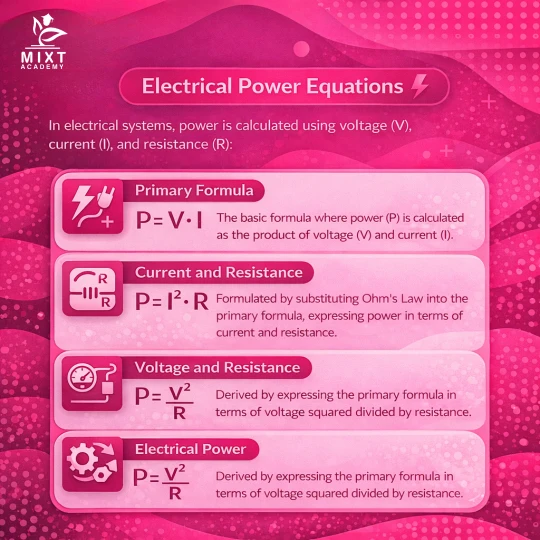
Alt: Electrical power equations showing relationships between voltage, current, and resistance in physics
In electrical systems, power is calculated using voltage (𝑉), current (𝐼), and resistance (𝑅):
- Primary Formula: 𝑃=𝑉⋅𝐼
- Current and Resistance:
- Voltage and Resistance: 𝑃=𝑉2𝑅
Units of Measurement
- Watt (W): The standard SI unit, equal to 1 Joule per second (J/s).
- Horsepower (hp): Often used for engines; 1 hp is approximately equal to 746 Watts
How can I avoid common mistakes and improve my exam scores in power equations?
With Mixt Academy’s online tutoring, students receive expert guidance and personalised support to master power equations efficiently.
Summary Table of Variables
| Symbol | Quantity | SI Unit |
|---|---|---|
| P | Power | Watt (W) |
| W | Work | Joule (J) |
| t | Time | Second (s) |
| F | Force | Newton (N) |
| v | Velocity | m/s |
| V | Voltage | Volt (V) |
| I | Current | Ampere (A) |
| R | Resistance | Ohm (Ω) |
Real-Life Applications of Power
Power plays an essential role in our everyday lives by measuring how quickly work is done or energy is used. Some common real-life applications of power include:
- Electrical Appliances: Devices such as fans, refrigerators, heaters, and air conditioners are rated in watts, indicating how much electrical power they consume.
- Automobiles and Engines: The performance of car and bike engines is measured in horsepower or kilowatts, showing how fast the engine can do work.
- Electricity Bills: Electrical energy consumption is calculated using kilowatt-hours (kWh), which is the product of power and time.
- Machines and Motors: Industrial machines are designed based on their power ratings to ensure efficiency and safe operation.
- Sports and Human Activity: Power is used to compare athletic performance, such as how quickly a person can lift weights or climb stairs.
- Renewable Energy Systems: Solar panels and wind turbines are rated by power output, which indicates how much energy they can produce per second.
Common Mistakes Students Make in Power-Related Numericals
Students often lose marks in physics due to small but avoidable errors when solving numerical and theoretical questions on power. Some of the most common mistakes include:
- Confusing power with energy, even though they are different physical quantities.
- Treating kilowatt-hour (kWh) as a unit of power instead of energy.
- Applying the wrong power formula without analysing the given data.
- Forgetting to convert values into SI units before performing calculations.
- Ignoring or omitting units in the final answer.
- Mixing up electrical power equations with mechanical power equations.
Enhance Your Understanding of Physics Concepts with Expert Tutors

Alt: Expert tutors helping students improve physics understanding through interactive online learning
Struggling to master the power equation in physics? Mixt Academy’s online tutors provide step-by-step explanations, real-life examples, and personalised support to help you understand mechanical, electrical, and rotational power formulas. Start practising effectively today, avoid common mistakes, and build confidence to excel in your Class 9–12 physics exams. Book your free demo now!
How Can I Master Power Equations Effectively?
Power in physics measures how quickly work is done, or energy is transferred. It is a scalar quantity with the SI unit watt (W). Key formulas include:
- General: P = W / t
- Mechanical: P = F · v
- Electrical: P = V · I, P = I²R, P = V² / R
- Rotational: P = τ · ω
Power can be average or instantaneous, and common units also include horsepower (hp) and kilowatt-hours (kWh). Real-life applications range from electrical appliances and engines to sports and renewable energy.
Avoiding common mistakes, like confusing power with energy or using the wrong units, ensures accuracy. Mastering these concepts provides a strong foundation for exams and practical physics